
Direct answer: Trailer weight limits in African countries are not controlled by one single Africa-wide rule. Buyers should check the country of registration, the countries crossed, axle group limits, gross combination weight, bridge and road restrictions, weighbridge enforcement, and abnormal-load permits before choosing trailer payload. The safest approach is to design the trailer around the lowest practical limit on the route, not only the factory-rated payload.
For fleet buyers, weight limits affect more than fines. They affect axle layout, tire choice, suspension, brake system, loading method, fuel cost, road damage risk, permit timing, and resale value. A trailer that is legal in one corridor may still create problems when it crosses a border, carries a concentrated load, or moves through a mining or construction road with stricter controls.
Quick Buyer Decisions
- Confirm the working route before choosing payload: local delivery, cross-border corridor, mine road, port route, or regional transit.
- Check axle group limits and gross vehicle or combination weight separately.
- Treat a high factory payload as a technical capacity, not an automatic legal payload.
- Plan abnormal-load permits for oversized, overweight, or unusual cargo.
- Keep a loading diagram for heavy equipment, steel coils, containers, aggregates, fuel, or machinery.
- Use common tire sizes and axle parts that can be serviced on the route.
Why Africa Needs Route-Based Weight Planning
African road freight often crosses several legal and physical environments in one trip. A trailer may be imported through Mombasa, Durban, Walvis Bay, Maputo, Lagos, Tema, Abidjan, or Douala, then move inland through border posts, weighbridges, and rough secondary roads. That means a buyer should not ask only, “How many tons can this trailer carry?” The better question is, “How many tons can this trailer carry legally and reliably on this route?”
The World Bank Logistics Performance Indicators 2.0 page, accessed June 18, 2026, says the latest dataset covers 2023-2024 and highlights unpredictability around ports, transshipment hubs, and inland checkpoints. For trailer buyers, axle-load control is one of those checkpoint risks. A delayed or overloaded truck can create storage cost, delivery penalties, and maintenance damage.
The Three Weight Numbers Buyers Must Separate
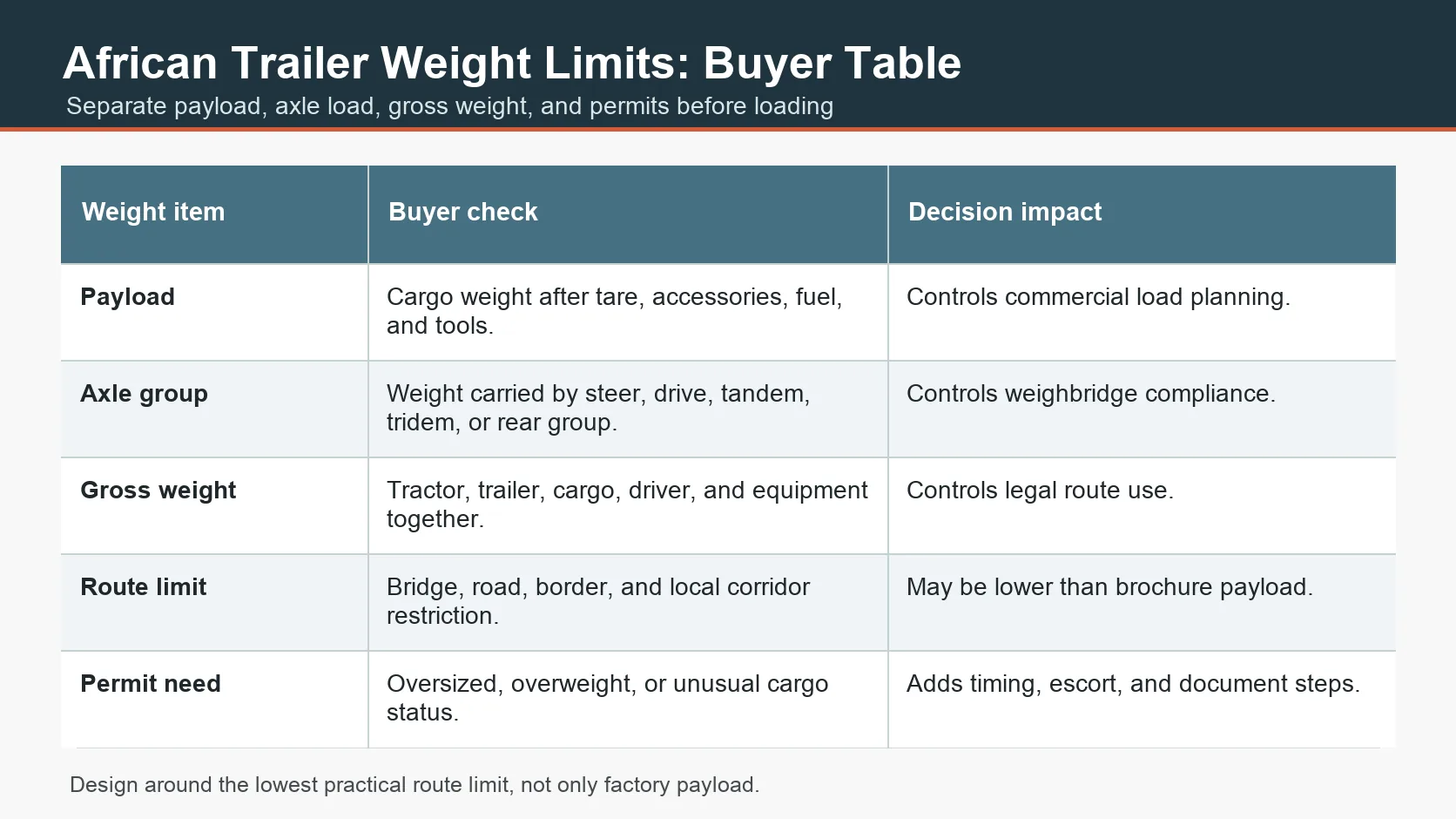
Do not mix payload, axle load, and gross weight. They answer different questions.
| Weight term | What it means | Buyer mistake to avoid |
|---|---|---|
| Tare weight | Empty trailer weight | Ignoring heavier body or stronger frame |
| Payload | Cargo weight trailer can carry technically | Treating factory payload as legal payload everywhere |
| Gross trailer weight | Trailer plus cargo | Forgetting landing gear, spare tire, and accessories |
| Gross combination weight | Tractor, trailer, cargo, fuel, driver, and tools | Comparing only trailer payload without tractor weight |
| Axle load | Weight carried by one axle or axle group | Loading too much cargo over one group |
| Bridge or road limit | Route-specific restriction | Planning by national limit without checking route |
The existing article Trailer Axle Load Capacity for African Roads explains why axle distribution can matter more than the headline payload printed in a brochure.
Country and Corridor Examples
The exact limit must be confirmed locally before shipment or loading. But these official sources show why buyers need country-by-country checking.
| Country or corridor signal | What the buyer should learn |
|---|---|
| Kenya | The Kenya National Highways Authority axle load control page, accessed June 18, 2026, is the official route into Kenya axle-load control information. Buyers moving through Mombasa should confirm current weighbridge rules before the first trip. |
| Botswana | The Government of Botswana Axle Load Control monitoring page, accessed June 18, 2026, says vehicles above 3,500 kg are weighed at weighbridges and lists several weighbridge locations. |
| Botswana abnormal loads | The Government of Botswana axle-load exemption certification page, accessed June 18, 2026, covers certificates for abnormal loads. |
| South Africa | The South African Government National Road Traffic Act page, accessed June 18, 2026, provides the national legal foundation for road traffic matters. Buyers should use the current regulations and route permits, not informal tables. |
This is why a fleet that works in East Africa, Southern Africa, and West Africa should keep separate route files. The trailer may be physically capable of carrying the cargo, but the corridor may require a different loading pattern, permit, or axle configuration.
Trailer Specification Choices Affected by Weight Limits
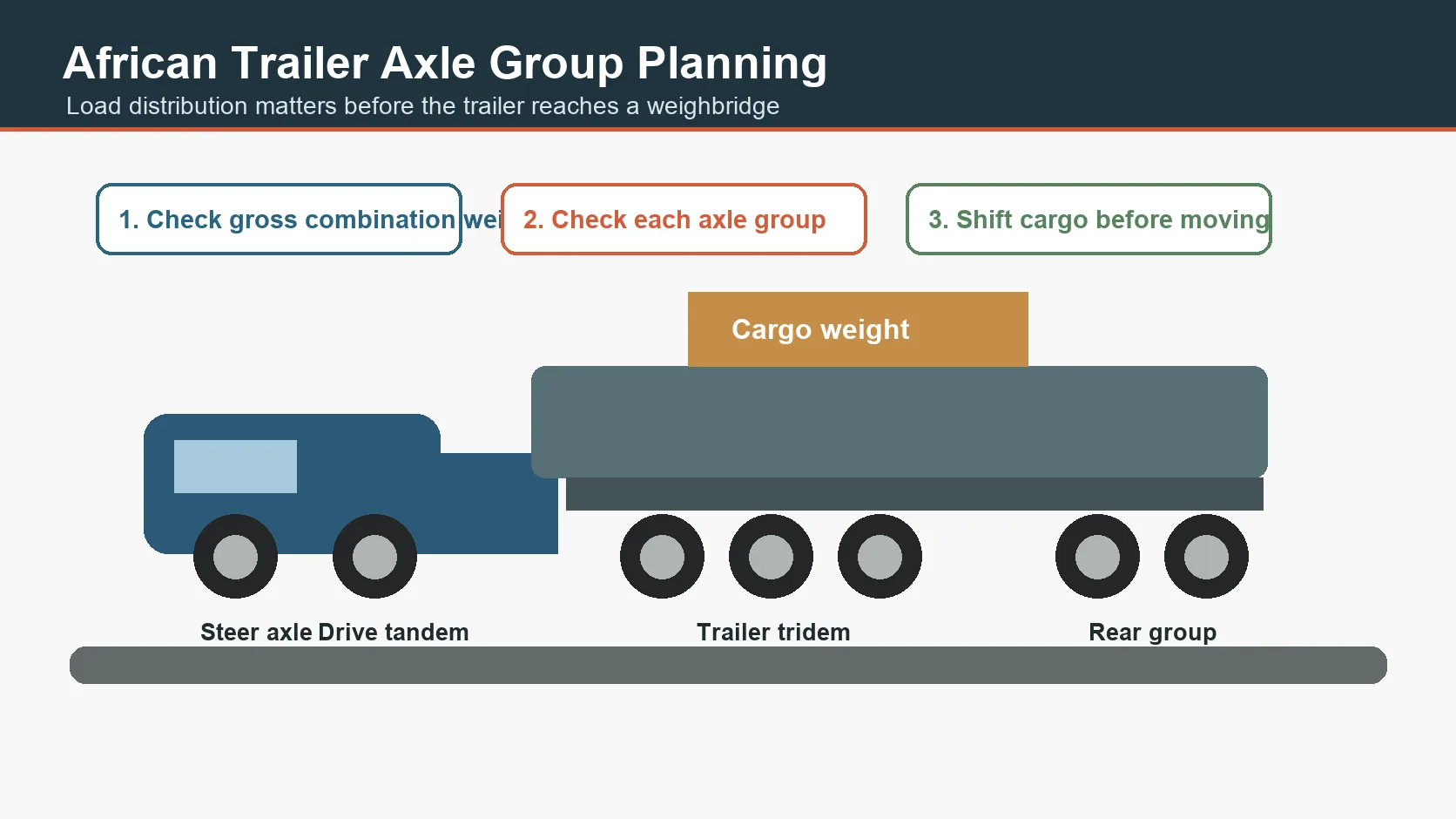
Weight limits influence nearly every technical choice on a semi-trailer.
| Specification | Weight-limit impact |
|---|---|
| Axle count | More axles may improve load distribution but add cost and maintenance |
| Axle spacing | Affects axle group load and bridge stress |
| Suspension | Mechanical suspension is rugged; air suspension can help load sharing when maintained well |
| Tire rating | Tire load index must match expected axle loads |
| Deck length | Longer deck can help distribute cargo but changes turning and route access |
| Frame strength | Stronger frame protects durability but increases tare weight |
| Brake system | Heavier loads require reliable air system, chambers, valves, and maintenance |
| Kingpin and landing gear | Must match tractor and loaded operating conditions |
For rough-road routes, read How to Choose Trailer Suspension for the African Market before choosing mechanical suspension, air suspension, or special reinforcement.
Product-Specific Weight Planning
Different trailer types create different weight-limit risks.
| Trailer type | Main weight risk | Buyer check |
|---|---|---|
| Flatbed trailer | Concentrated steel, machinery, or bagged cargo | Mark loading zones and tie-down positions |
| Side wall trailer | Heavy agricultural or construction cargo loaded unevenly | Check side wall strength and axle balance |
| Lowbed trailer | Heavy machine centered on deck | Confirm machine center of gravity and route permits |
| Tipper trailer | Dense aggregates or wet material | Control body volume so payload is not exceeded |
| Fuel tank trailer | Liquid surge and compartment distribution | Confirm compartment plan and safety fittings |
| Skeletal trailer | Container weight and twist-lock position | Confirm 20ft or 40ft container load distribution |
If the buyer is moving machinery, compare the Lowbed Semi-Trailer specification early. For construction material, the guide on tipper trailer specification for construction in Africa can help prevent over-ordering a body volume that becomes illegal or unsafe when filled with dense aggregate.
Loading Method Matters as Much as Trailer Strength
Even a legal trailer can become overloaded on one axle group if the cargo is placed badly.
Common loading mistakes include:
| Mistake | Result |
|---|---|
| Heavy machine parked too far rearward | Overloaded trailer axle group |
| Steel bundles placed in one short stack | Concentrated deck and axle stress |
| Container carried without weight declaration | Unknown axle distribution |
| Wet sand or gravel loaded by volume only | Payload exceeds plan after moisture |
| Fuel compartments filled unevenly | Poor axle balance and surge risk |
For agricultural cargo, the article Flatbed Trailer for Agricultural Transport in Africa explains why bagged cargo, fertilizer, timber, and farm equipment need different deck and tie-down planning.
Pre-Shipment Buyer Checklist
Before the factory finishes the trailer, ask for a technical check package:
| Check | Required detail |
|---|---|
| Route | Countries, border posts, port, mine or warehouse destination |
| Cargo | Weight, dimensions, loading method, center of gravity |
| Trailer | Axle count, axle spacing, tire size, suspension, tare weight |
| Tractor | Fifth-wheel height, kingpin match, engine and brake capacity |
| Legal file | Local weight limit, permit need, abnormal-load status |
| Maintenance | Spare tire, brake fittings, air lines, lights, wheel nuts |
| Inspection | Factory photos, loading photos, arrival photos |
How to Avoid Overload Problems After Delivery
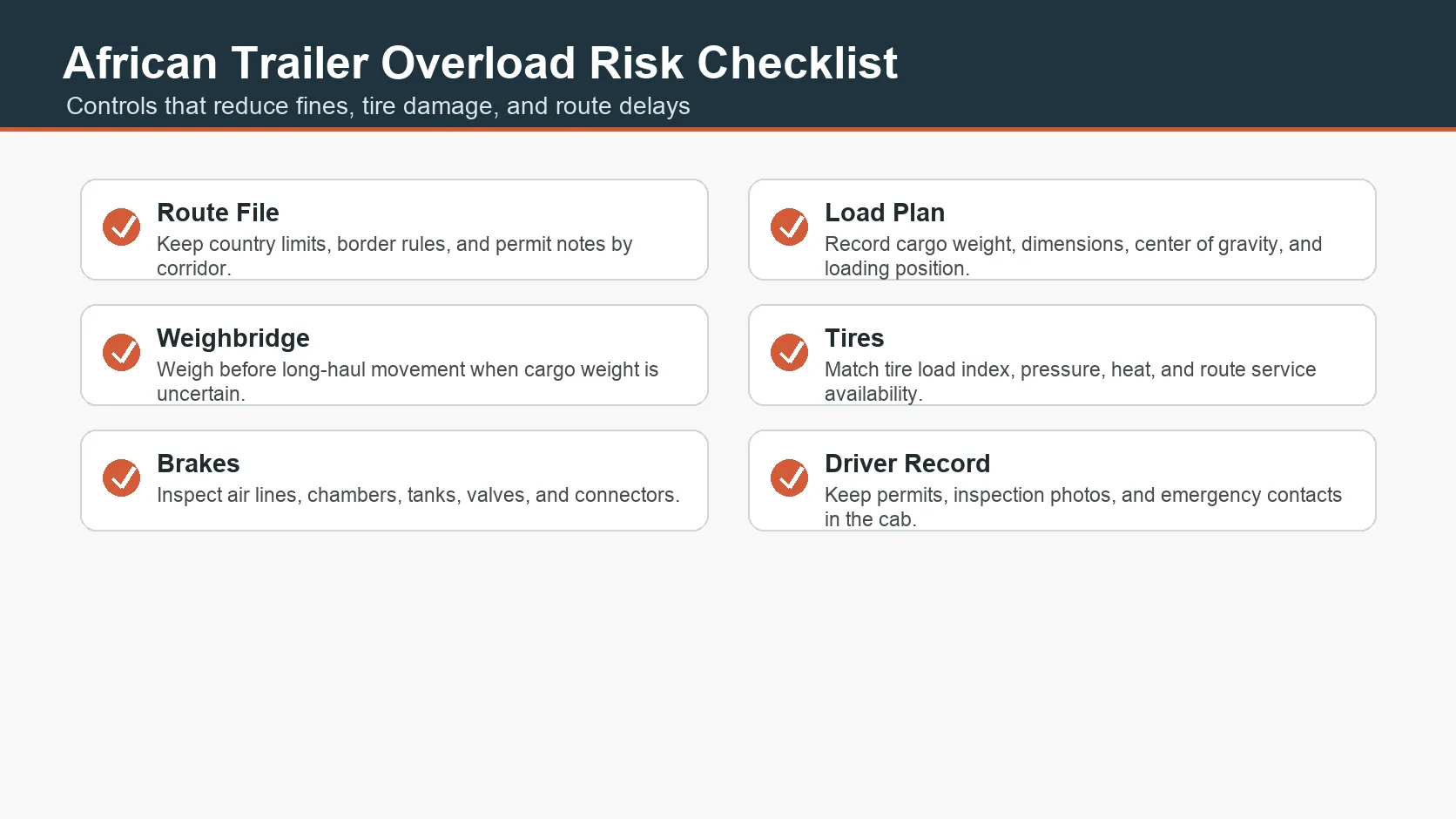
After the trailer arrives, the buyer should train drivers and loaders. Many overload problems happen because the loading crew uses the body volume or deck space as the limit instead of the legal payload and axle distribution.
Use these controls:
| Control | Practical action |
|---|---|
| Load sheet | Keep cargo weight, loading position, and route in writing |
| Weighbridge record | Weigh before long-haul trips when possible |
| Tire check | Record pressure and tire condition before departure |
| Driver checklist | Include lights, brakes, coupling, air lines, and load securement |
| Maintenance schedule | Inspect suspension, brake chambers, rims, and wheel nuts |
| Permit log | Keep abnormal-load permits and route approvals with the driver |
Conclusion
Trailer weight limits in African countries must be treated as a route-specific design input. The buyer should check country rules, corridor enforcement, axle group load, gross combination weight, cargo placement, and abnormal-load permits before choosing a trailer. The best trailer is not simply the one with the largest advertised payload. It is the one that can carry the intended cargo legally, safely, and repeatedly on the real route.