
Most semi-trailers use one of two kingpin sizes: 2 inch (50.8 mm) or 3.5 inch (88.9 mm). For heavy loads on rough African roads, many operators choose the 3.5-inch kingpin. But the right size depends on your tractor's fifth wheel and your cargo.
This guide explains both sizes, which one suits African conditions, how to check compatibility, and how to source the right trailer. The short answer is simple: match the kingpin to your tractor first, then match the whole trailer build to the route and load.
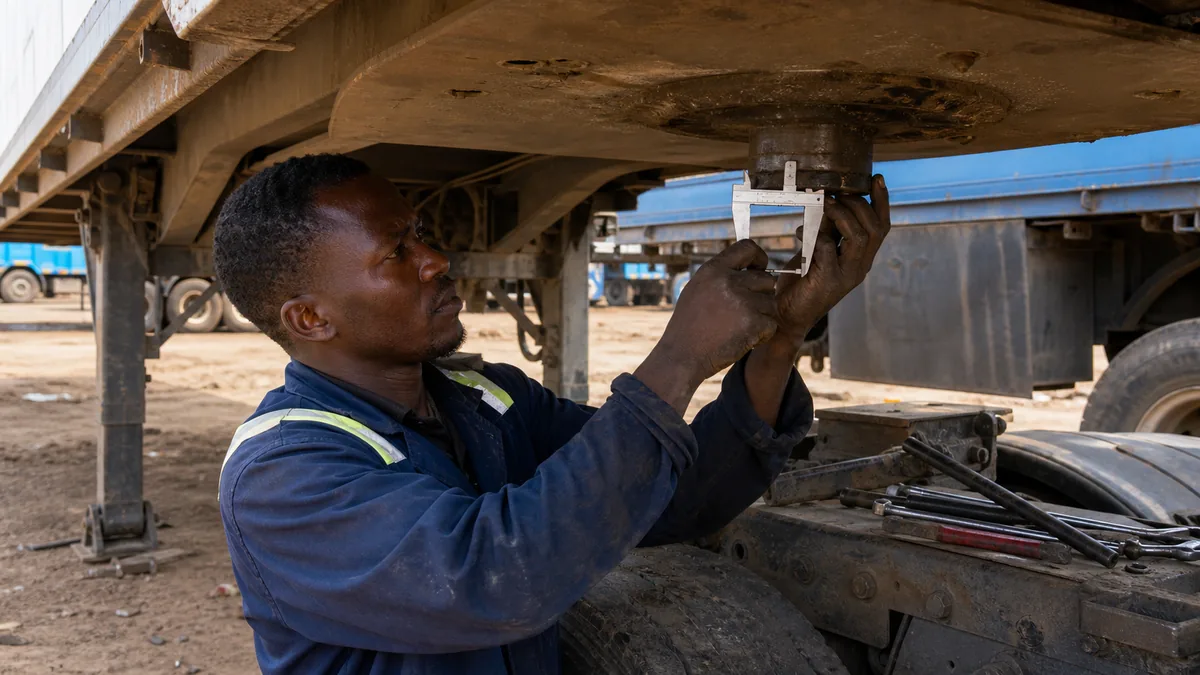
What Is a Trailer Kingpin, and Why Size Matters
Trailer kingpin: A vertical steel pin under the front of a semi-trailer. It locks into the tractor's fifth wheel and joins the two together.
The kingpin carries the front load of the trailer. It also takes pulling force, braking force, and turning force. So the size is not a small detail.
A bigger pin can handle a heavier load. The wrong size will not lock in safely. That creates a real road safety risk.
Two sizes are standard worldwide. One is 2 inch. The other is 3.5 inch. Both follow recognized coupling standards, including 50 mm and 90 mm international references used in export trailer markets. The size you need depends on your load and the fifth wheel on your truck.
Here is how the lock works. The kingpin slides into the jaws of the fifth wheel. The jaws close around the pin and hold it. If the pin is the wrong size, the jaws cannot grip it correctly. The result is a loose or unsafe coupling.
The heavier the load, the more the pin must hold. A 2-inch pin is rated for normal freight. Push past its limit and you put stress on the coupling. This is why load and size go together. Pick the pin for your heaviest real load, not your average one.
2-Inch vs 3.5-Inch Kingpin: The Two Sizes Compared
The two sizes look similar from a distance, but they do different jobs. Here is how they compare.
| Feature | 2-Inch Kingpin | 3.5-Inch Kingpin |
|---|---|---|
| Diameter | 50.8 mm, often called 50 mm | 88.9 mm, often called 90 mm |
| Typical load range | Standard freight and normal road work | Heavy haul and high-stress routes |
| Best for | Dry vans, flatbeds, tankers, general freight | Lowbeds, mining loads, quarry work, overweight cargo |
| Fifth wheel needed | Standard 2-inch fifth wheel | Heavy-duty 3.5-inch fifth wheel |
| Maintenance | Standard checks | More frequent inspection |
| Cost | Lower | Higher |
You may also see these sizes in millimeters. A 2-inch pin is about 50 mm. A 3.5-inch pin is about 90 mm. Suppliers in export markets often use the metric names. Both naming styles point to the same two standard parts. So a "50 mm" pin and a "2-inch" pin mean the same size.
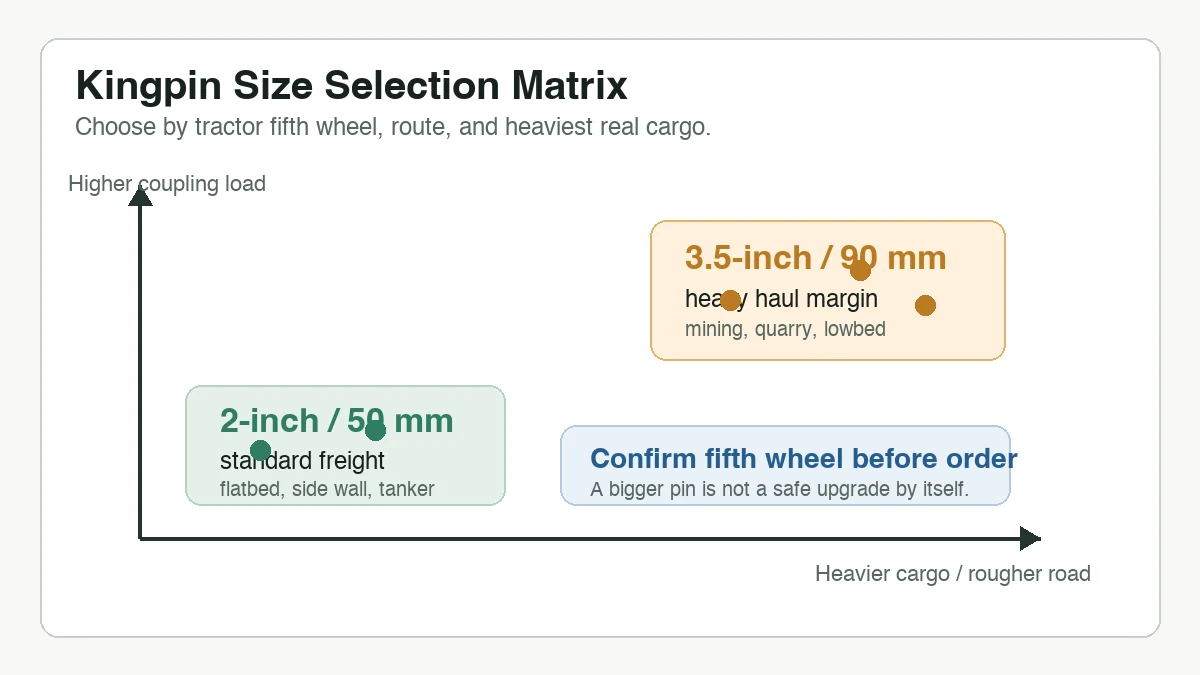
The 2-inch pin is the common choice. It suits most general freight. It fits standard fifth wheels found on many road tractors.
The 3.5-inch pin is built for heavy work. It gives a stronger lock under high load. But it needs a fifth wheel made for that size. You cannot mix the two safely.
In short, the 2-inch pin covers most everyday freight at lower cost. The 3.5-inch pin trades cost for strength when the load is high. Your load and your fifth wheel decide which one is right.
Welded vs Bolted Kingpins
Kingpins also come in two mounting types. This choice affects repair, not only the first purchase price.
- Welded kingpin: Fixed to the trailer plate by weld. Strong and permanent. Harder to replace.
- Bolted kingpin: Held by bolts. Easier to replace if worn or damaged.
For fleets that run hard on rough roads, a bolted pin can lower long-term repair cost. A worn pin is quicker to change. Confirm the mounting type when you order, along with the size.
For used equipment checks, the guide on used semi-trailer inspection explains why the kingpin, brake system, frame, tires, and documents should be inspected together.
Which Kingpin Size Suits African Roads and Loads
For heavy haul on rough roads, the 3.5-inch kingpin is often the safer choice.
The reason is simple. African routes are hard on equipment. Loads are heavy. Roads can be rough. The link between trailer and tractor takes constant stress on every trip.
Mining, quarry, and construction work make this harder. The cargo is dense. Ore, sand, gravel, and stone push the load to the limit. A 2-inch pin can handle general freight. But under this kind of weight, the 3.5-inch pin gives more margin.
A 3.5-inch kingpin makes the most sense in these cases:
- Mining and quarry haul: Heavy ore, sand, and gravel need a stronger coupling.
- Construction transport: Tippers and lowbeds carry dense, heavy loads.
- Overweight or long-haul freight: A bigger pin gives more margin when the load path is designed for it.
- Rough, unpaved roads: Constant shock favors the heavier connection.
A 2-inch kingpin still fits well in these cases:
- General dry-van or flatbed freight: Standard loads on better roads.
- Container and farm cargo: Many 40 ft flatbed and side wall routes do not need a 3.5-inch pin.
- Existing 2-inch fleets: One size keeps trailers and tractors interchangeable.
Start with your cargo and route, not the pin. Match the trailer to the work first, then confirm the kingpin size. For standard freight choices, see the 40 ft 3 Axle Flatbed Container Semi Trailer. For heavier equipment routes, compare the Lowbed Semi-Trailer and the Multi-Axle Air Suspension Low Bed Semi Trailer.
Match the Whole Heavy-Duty Build, Not Just the Pin
The kingpin is one part of a heavy-duty trailer. On African routes, the rest of the build matters just as much.
A 3.5-inch pin works best with a matching setup. That means a heavy-duty fifth wheel, a strong front frame, and enough axles for the load. High-strength steel resists twisting on rough ground. Three axles or more help spread heavy weight on poor roads.
The pin, the frame, and the axles work as one system. Confirm them together, not one at a time. A strong pin on a weak frame still fails early.
The article on trailer axle load capacity for African roads is useful here. Coupling strength, axle layout, tire rating, suspension, and legal load limits should be checked as one package.
Need to match the pin, fifth wheel, and trailer build?
Share your tractor model, cargo weight, route, and trailer type before production. We can help confirm whether a 2-inch or 3.5-inch kingpin fits your operation.
Example: A Tri-Axle Hydraulic Tipper for African Heavy Haul
Here is a real-world spec for a hydraulic tipper built for African routes. It shows how the parts work as one heavy-duty system.
- Body: 8,500 mm long, about 35 m3, for sand, gravel, ore, and earthwork.
- Steel: Heavy lower plate, reinforced floor, and strengthened end plate.
- Lifting: Full hydraulic cylinder set, for stable and fast tipping.
- Axles: Three 13T or 16T axles, on mechanical suspension.
- Kingpin: 2.0 inch or 3.5 inch, bolted or welded, matched to the tractor.
Look at the kingpin line. Even on a heavy tipper, both sizes may be offered. The 3.5-inch option is there for the heaviest loads. This is the exact choice this guide is about.
For construction fleets, the tipper trailer specification guide gives more detail on body steel, hydraulics, axles, and road conditions.
How to Confirm Kingpin Compatibility Before You Buy
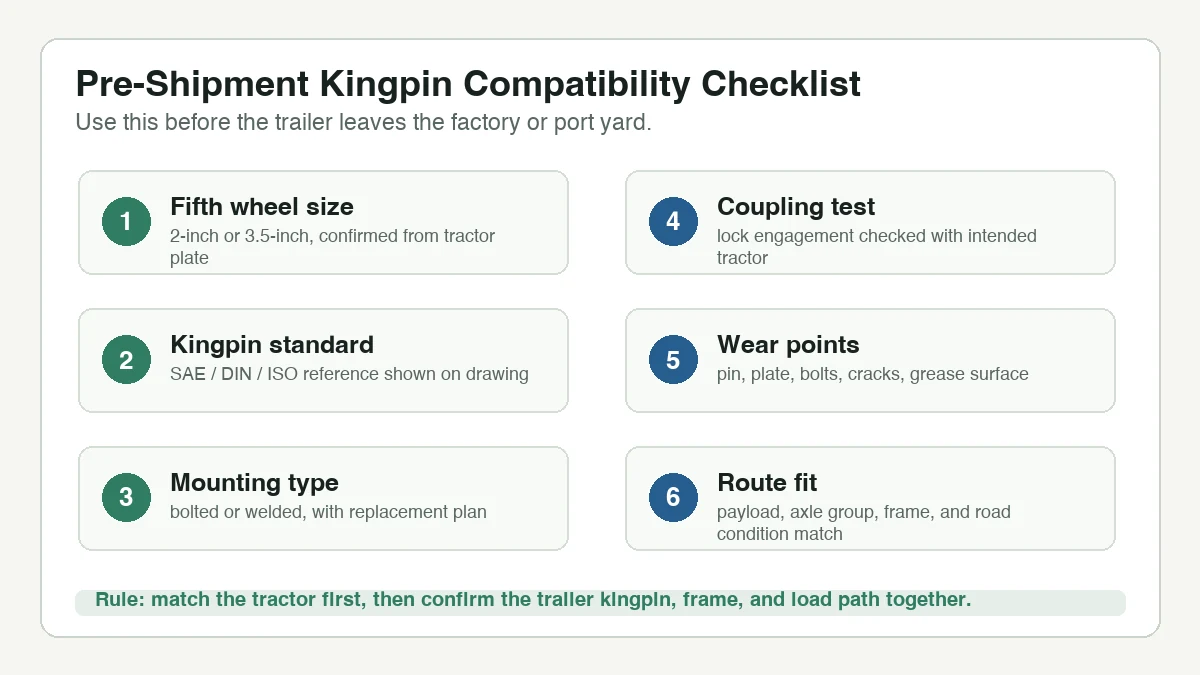
The kingpin must match the fifth wheel on your tractor. A 3.5-inch pin will not seat in a 2-inch fifth wheel. Check this before you order, not after. A mismatch is one of the most common and costly errors. In the worst case, the trailer will not couple at all.
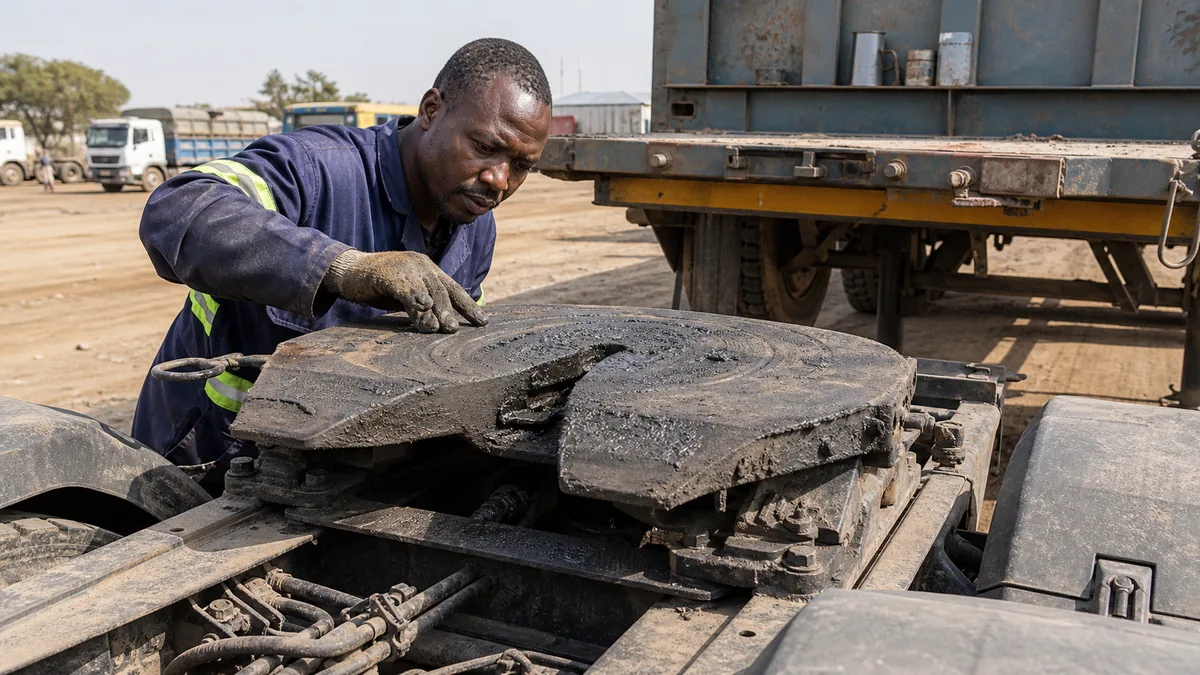
Run through this short checklist:
- Check your tractor's fifth wheel size first. 2-inch and 3.5-inch fifth wheels are different.
- Match the trailer kingpin to that size. Do not assume. Confirm it in writing.
- Confirm the kingpin standard and brand. Ask for the standard reference and a recognized brand where needed.
- Ask welded or bolted. Bolted pins are easier to replace later.
- Check the kingpin and plate for wear. A worn pin is a safety risk.
- Plan for mixed fleets. Keep one size where possible, so trailers and tractors stay interchangeable.
For tractor-side matching, a product such as the HOWO NX371 6×4 Tractor Truck for Semi Trailer Haulage should be checked against the trailer drawing before shipment. Confirm fifth-wheel size, fifth-wheel height, turning clearance, and loaded trailer level.
Q: How do I find my tractor's fifth wheel size?
A: Check the fifth wheel spec plate or the truck maker's manual. If in doubt, measure the jaw opening or ask your supplier. Confirm it before you match a trailer.
Q: Can I use an adapter to fit a 3.5-inch kingpin to a 2-inch fifth wheel?
A: Adapters exist, but treat them as a backup, not a default. For heavy haul, match the pin and fifth wheel from the start. Confirm the load rating before you rely on one.
Sourcing the Right Semi-Trailer for African Operations
Semi-trailers are built new and made to order. For fleets, dealers, and importers, the right questions go past price. They cover specs, supply, and delivery.
Q: Should I just match my existing fleet's kingpin size?
A: Usually yes. One consistent size keeps trailers and tractors interchangeable. Confirm it before you order.
Q: What specs should I confirm with the supplier?
A: Kingpin size and standard, fifth-wheel match, axle count, payload, suspension, frame, and route condition. Get all of them in writing.
Q: How are trailers delivered to Africa?
A: Often by RO-RO as a fully assembled unit, or by container or bulk vessel depending on trailer type and route. Confirm lead time, port, and discharge plan before production.
When you ask for a quote, send your details up front. List your cargo, your load weight, your route, and your tractor's fifth wheel size. Clear specs get you a clear quote. They also cut back-and-forth and lower the risk of a wrong order.
For fleets and dealers, stable supply matters more than a one-off low price. Consistent specs keep your fleet simple to run and repair. To check build quality and manufacturing background, see about FrogAuto.
If the trailer will work in mining or off-highway transport, the guide on lowbed trailer selection for mining in Congo gives a useful example of matching payload, axles, ramps, route risk, and supplier checks.
Conclusion
The right kingpin size starts with two checks. Confirm your tractor's fifth wheel, then match the trailer to your cargo and route. For most heavy haul on African roads, that points to a 3.5-inch pin and a heavy-duty build. For lighter freight on better roads, a 2-inch pin keeps cost down.
Get the size right and the rest gets easier. The trailer couples safely. The fleet stays interchangeable. Repairs stay simple. Get it wrong and you pay for it on every trip.
Ready to confirm a trailer build before shipment?
Send your tractor model, route, cargo weight, target payload, and preferred trailer type. FrogAuto can help check kingpin size, fifth-wheel fit, axle layout, delivery, and export details.