
A semi trailer junction box is small, but it controls every light on the trailer. Get it wrong, and you chase faults for years. This guide explains what the junction box does, the 7-way wiring diagram, how to wire and seal it, and how to match the voltage to your tractor. The focus is heavy haul on African roads.
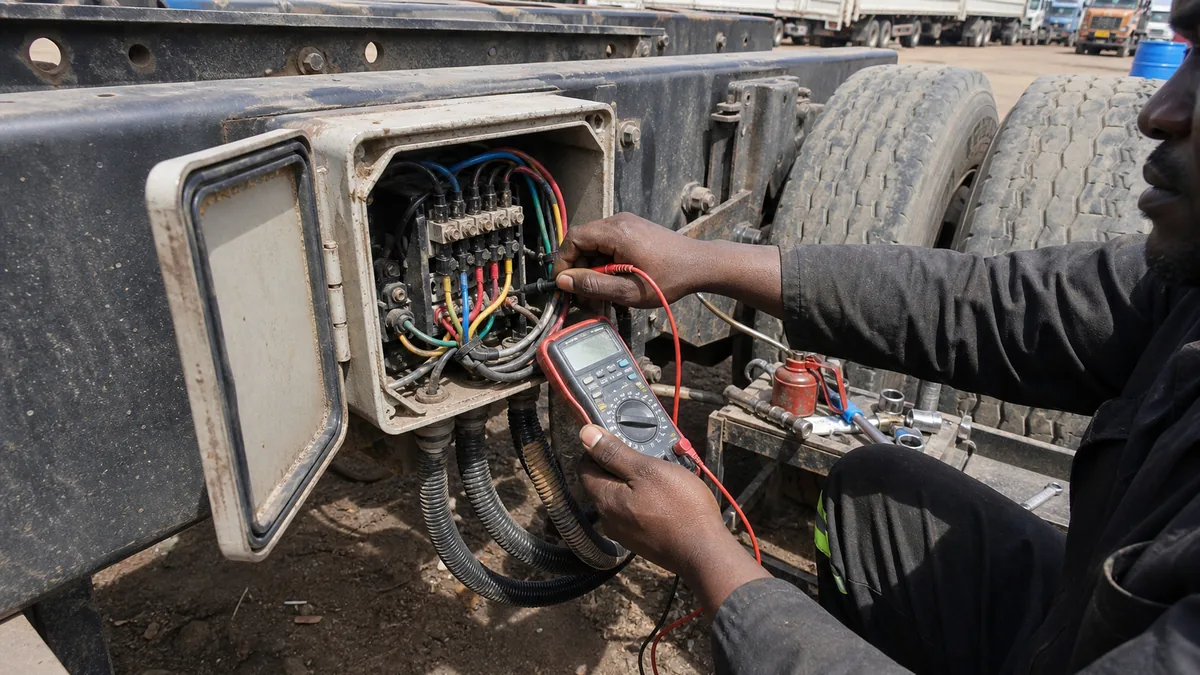
What Is a Semi Trailer Junction Box?
Semi trailer junction box: A sealed box on the trailer where the main 7-way cable from the tractor connects and splits out to each light circuit and ground.
The junction box is a distribution point. One cable comes in from the tractor. Inside the box, each wire branches out to the tail lights, markers, turn signals, and brake lights. The ground connects here too. A good box uses bolted terminal studs. You can open it, test each stud, and fix a fault in minutes.
This is also the number one fault point. Every circuit passes through this box. It sits low on the trailer, exposed to water, dust, and vibration. On rough African roads, that stress is constant. One loose or corroded terminal here can kill a light at the back of the trailer. Buyers comparing new builds in the semi trailer category should confirm junction box photos before shipment, not only the trailer model.
The 7-Way Junction Box Wiring Diagram (Pins and Colors)
Most heavy semi trailers use a 7-way round connector to the SAE J560 standard. Here is the standard pin layout, function, and wire color.
| Pin | Function | Wire Color | Gauge |
|---|---|---|---|
| 1 | Ground (-) | White | 8-10 AWG |
| 2 | Clearance / marker / ID lamps | Black | 12 AWG |
| 3 | Left turn signal | Yellow | 12 AWG |
| 4 | Stop lamps | Red | 10-12 AWG |
| 5 | Right turn signal | Green | 12 AWG |
| 6 | Tail and license plate lamps | Brown | 12 AWG |
| 7 | ABS power / auxiliary | Blue | 10 AWG |
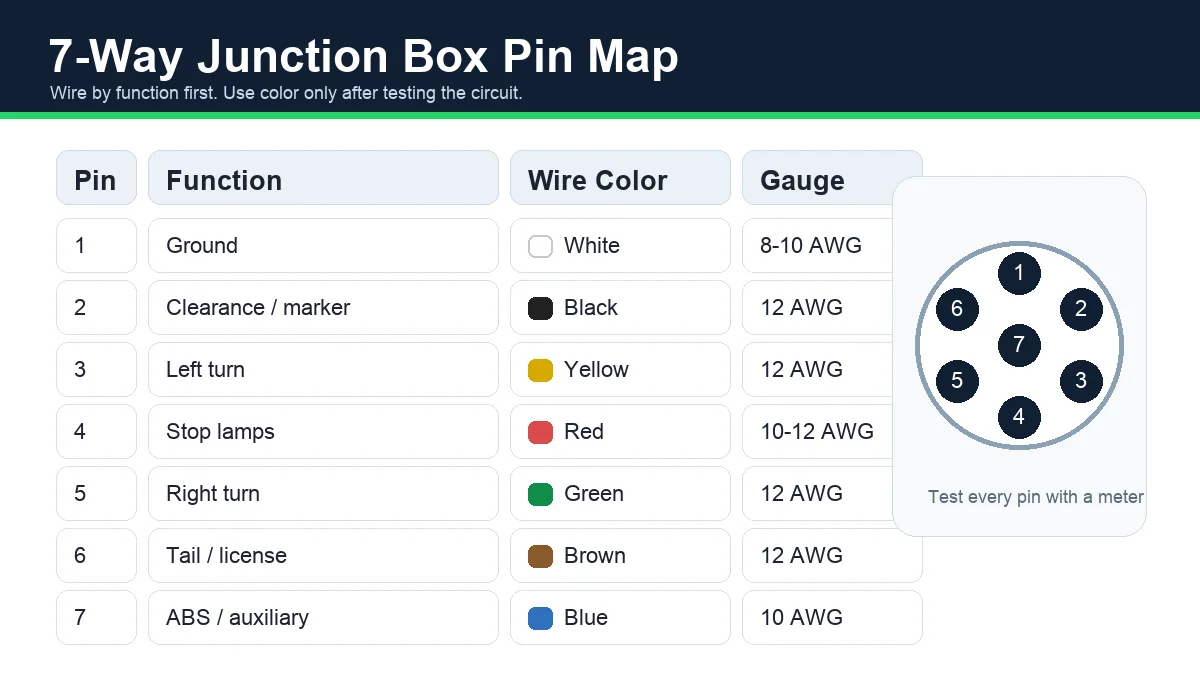
One rule matters more than the table: wire by function, not by color. Color codes are not universal. A wire that looks black on one trailer may carry a different signal on another. Always test each pin with a meter before you connect it. The white ground and the heavier gauge on pins 1, 4, and 7 are the parts to get right first.
How to Wire and Seal a Junction Box for African Roads
Start at the box and work outward. The steps are simple. The grounding and sealing are what keep it working.
- Start at the junction box. Map each incoming wire to its function first.
- Match by function. Test each pin, then connect the matching light circuit.
- Ground to the frame. Run the ground to a clean stud bolted to the trailer frame.
- Seal every entry. Use rubber grommets so no wire hole is left open.
- Pack with dielectric grease. This blocks moisture and slows corrosion.
- Mount the box high. Keep it clear of water, mud, and road spray.
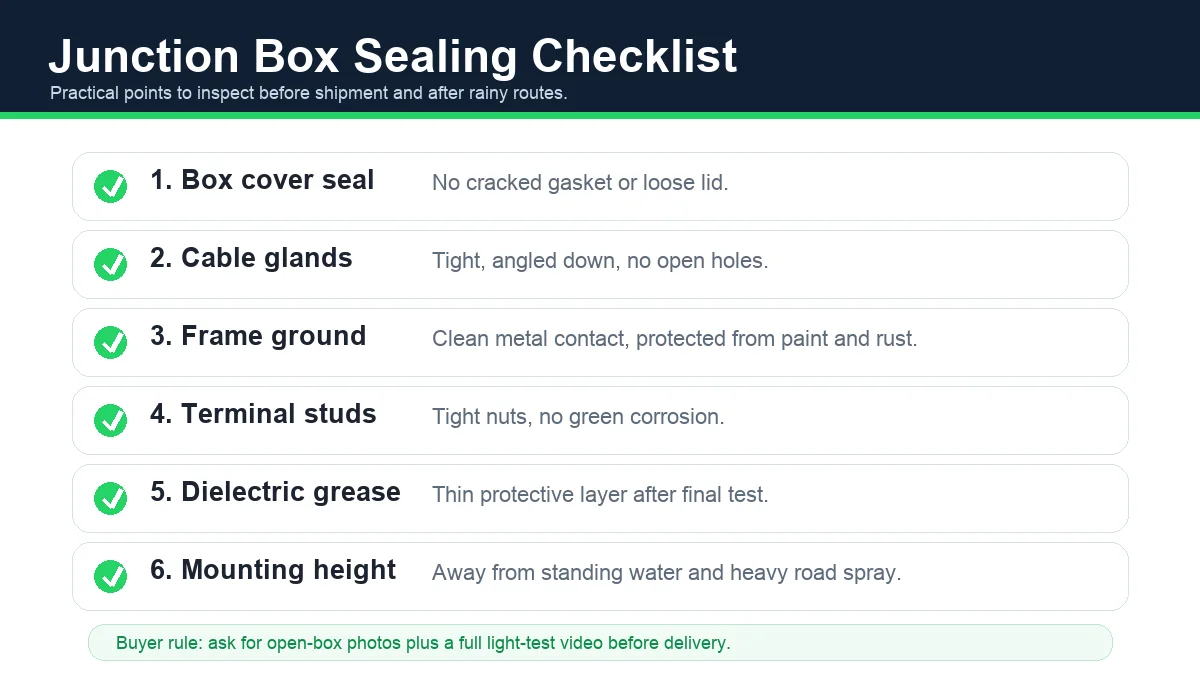
Grounding causes most trailer light faults. A bad ground makes lights flicker, dim, or die. Run a solid ground to the frame, and check it first when anything fails.
Sealing matters even more in African conditions. Heat, dust, and water all attack the terminals. A box that is sealed and greased lasts far longer than one left open. The same logic applies to wider rainy-season inspections in our semi-trailer maintenance in tropical climate guide.
Need trailer wiring matched before shipment?
Send your tractor voltage, plug type, route, and trailer model. FrogAuto can confirm junction box wiring, sealing, and light-test photos before delivery.
12V or 24V? Match the Junction Box to Your Tractor
This is the step most buyers miss. The 7-way plug looks the same on a 12V and a 24V truck. But they are not the same system.
| Spec | SAE J560 | ISO 1185 (24N) |
|---|---|---|
| Voltage | 12V | 24V |
| Common on | North American trucks | European, Japanese, Chinese trucks |
| Pin 7 | ABS power / auxiliary | Trailer brake control |
| Mixing the two | Needs a converter | Needs a converter |
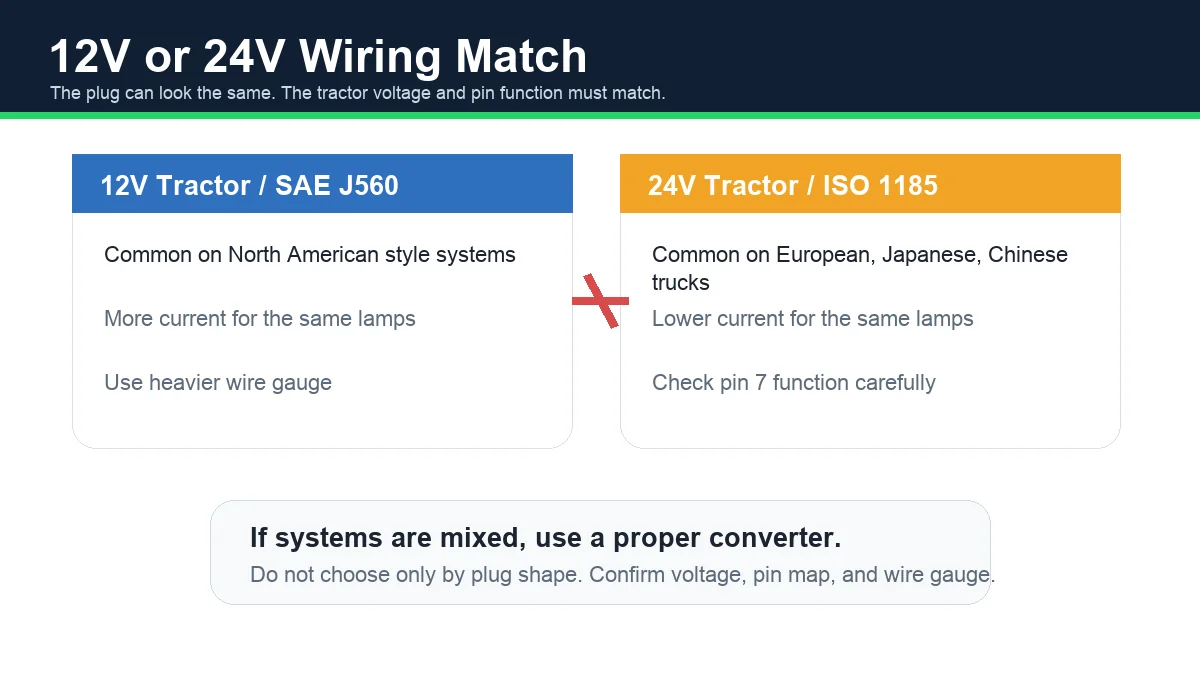
The plugs are physically the same. But a 12V trailer on a 24V tractor will not work right without a converter. Pin 7 can also behave differently between the two. So the connector alone tells you nothing.
There is one more reason to confirm voltage. For the same lights, a 12V system carries more current than a 24V system. That is why SAE J560 12V wiring uses a heavier wire gauge. Undersize the wire on a 12V trailer and you get voltage drop, dim lights, and heat. Match the gauge to the voltage, not just the plug.
African fleets often mix truck origins. Some run American 12V tractors. Many run European or Japanese 24V tractors. Before you order a trailer, confirm the voltage and pin standard of your tractors. Some newer rigs use a 13-pin or 15-pin connector instead. If your fleet uses a tractor such as the HOWO NX371 6×4 Tractor Truck for Semi Trailer Haulage, test the tractor and trailer together as one electrical system.
Common Problems and Sourcing Trailers Wired for Africa
Most junction box problems trace back to three causes. Here is how to find them fast.
Q: All trailer lights are dead. Where do I start?
A: Check the ground first. A loose or corroded ground stud is the most common cause.
Q: Lights flicker or work only sometimes.
A: Look for a loose terminal or corrosion inside the box. Clean it, tighten it, and re-grease it.
Q: One side or one function is out.
A: Test that single pin and circuit. The fault is in that wire, not the whole box.
For fleets and dealers, the fix starts before delivery. A new semi trailer should arrive wired to your market. That means the right voltage, the right connector, heavy enough wire gauge, and a sealed, well-grounded box. Built right, the junction box stops being a recurring problem.
A 40 ft 3 Axle Flatbed Container Semi Trailer should have wiring protected from cargo straps, forklift contact, and frame rubbing. A Fuel Tank Semi Trailer needs even stricter electrical discipline because fuel distribution work has tighter safety routines. Before choosing a supplier, the Chinese trailer manufacturer verification guide can help you check whether the factory can provide real photos, wiring details, and after-sales support.
To see the trailer types we supply, view our product overview or compare models in the semi trailer category. Once you know your tractor voltage and route, confirm the wiring standard, connector, and configuration before your order is built.
Ready to confirm trailer wiring for your fleet?
Tell us your destination country, tractor voltage, trailer type, and route conditions. We will help match the junction box, connector, wire gauge, and sealing plan.