
Direct answer: To become a trailer dealer in Africa, choose a country or route focus, define the buyer group, select 3 to 5 trailer models, verify suppliers, prepare import and landed-cost rules, build spare-parts support, create a simple sales process, and collect proof from each delivered unit. The dealer must sell confidence, not only trailers.
A trailer dealership is different from a small trading business. Buyers ask about payload, road condition, documents, warranty, delivery time, spare parts, and repair support. A good dealer can answer these questions before the buyer sends a deposit.
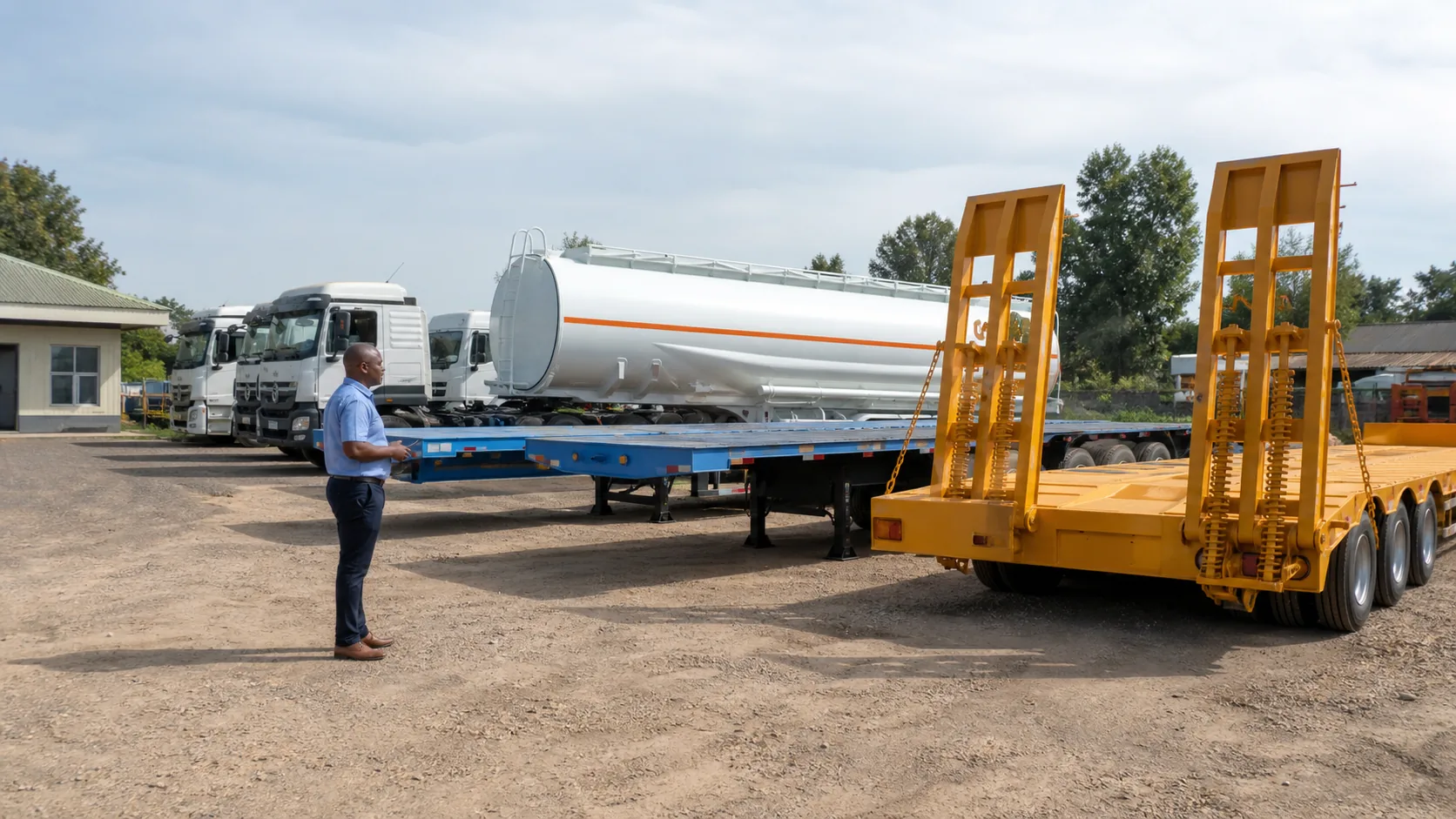
Quick Dealer Decisions
- Do not try to cover all African markets at the start.
- Pick one buyer group first: construction, mining, agriculture, fuel, container, or port trucking.
- Start with a small product mix and strong documentation.
- Verify the supplier before using its photos, prices, or warranty promise.
- Plan spare parts and workshop support before the first delivery.
- Track every inquiry in a simple CRM or spreadsheet.
Step 1: Choose Your Market Focus
Africa is too large for a new dealer to target in a general way. Start with a market that you can understand. A dealer in Nigeria may focus on Lagos port and construction customers. A dealer in Ghana may focus on Tema, used equipment buyers, and regional freight. A dealer in Zambia or Congo may focus on mining and lowbed transport.
Choose by these factors:
- Local demand you can see.
- Roads and cargo type in your area.
- Port or border access.
- Existing contacts in transport or construction.
- Repair workshops near your customers.
- Your ability to support import documents and after-sales.
The World Bank says transport supports trade, access, and economic opportunity on its transport overview. For a dealer, that means the market is real, but it is also practical. Buyers want vehicles that help them move cargo reliably.
Step 2: Define the Buyer Group
Do not sell the same message to every buyer. Each group cares about different problems.
| Buyer group | Main need | Dealer angle |
|---|---|---|
| Port trucking company | Container movement and fast turnaround | Flatbed, skeletal, tractor match, tire support |
| Construction contractor | Site material and machinery movement | Tipper, lowbed, heavy-duty frame |
| Mining operator | Payload and rough-road durability | Lowbed, axle layout, spare parts |
| Fuel distributor | Tank safety and delivery reliability | Tanker, fittings, safety checklist |
| Farm and agro trader | Seasonal cargo and rural roads | Flatbed, side wall, tire and suspension checks |
| New fleet owner | Price, finance, and first route | Simple package and landed-cost guidance |
When the buyer group is clear, the content, photos, stock, and sales pitch become much easier.
Step 3: Select the First Product Mix
A new dealer should not start with 20 models. Start with products that match the local buyer group and can be explained clearly.
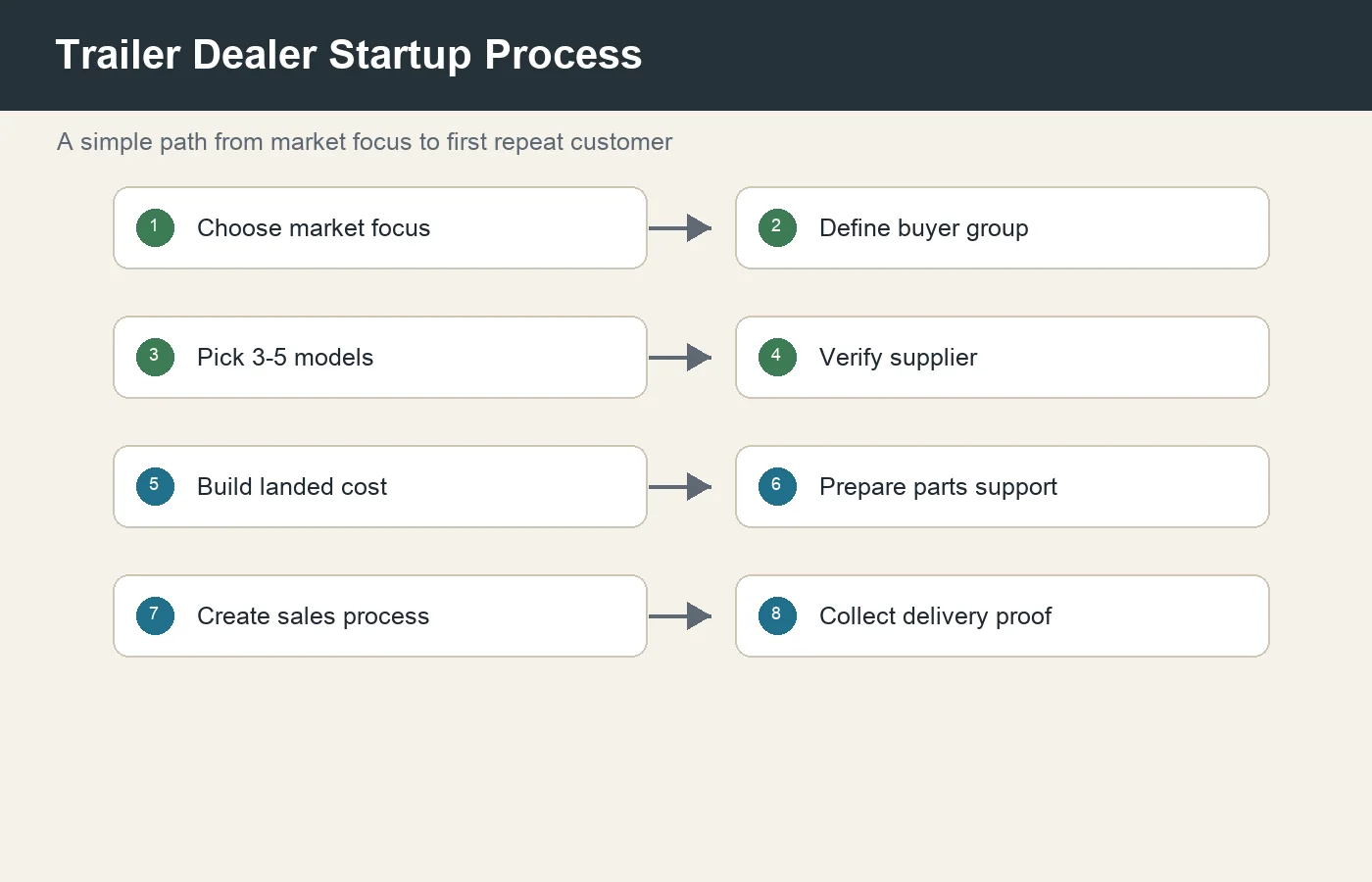
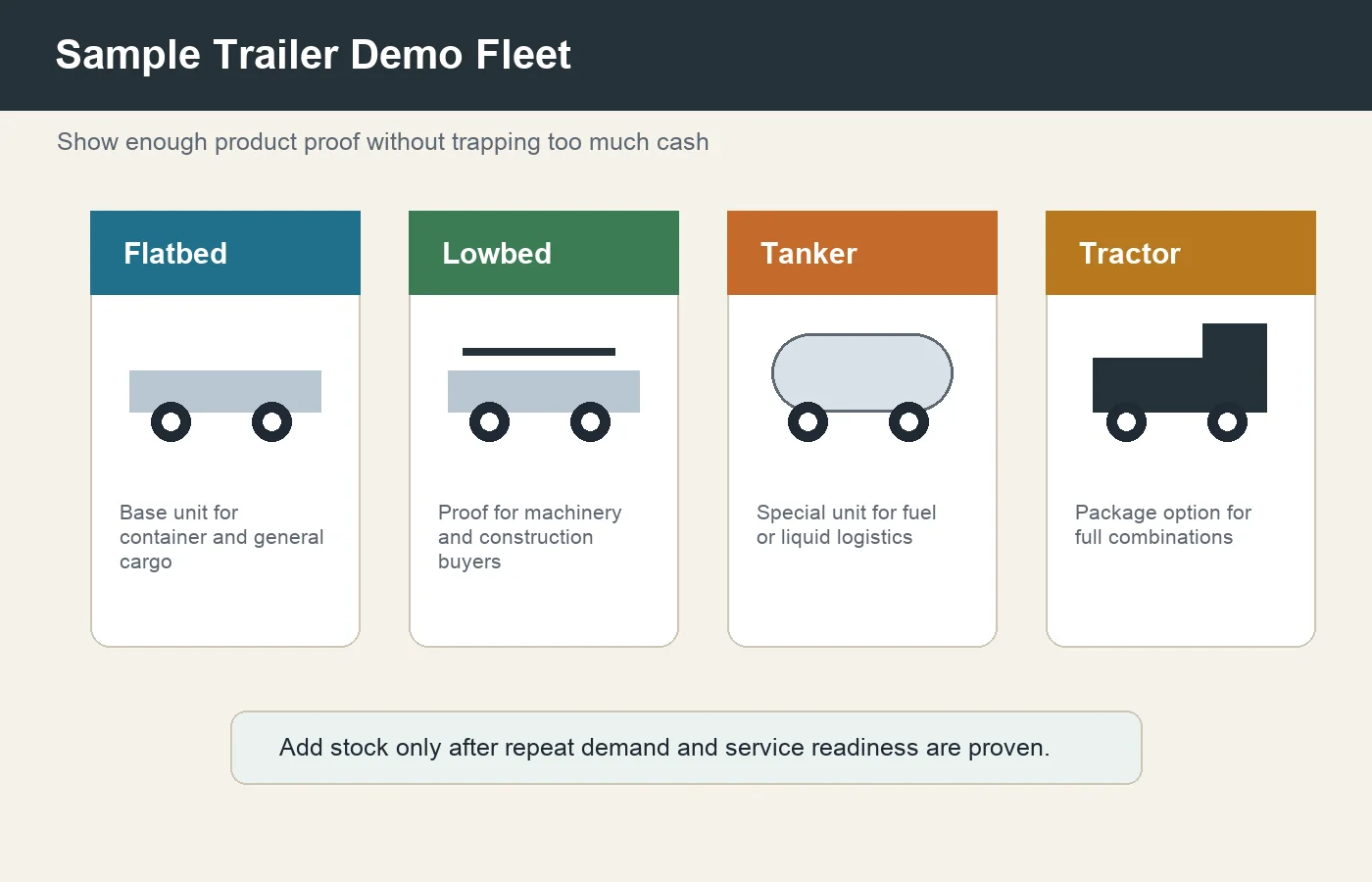
Base product mix for many markets
- 3-axle flatbed semi-trailer.
- Lowbed semi-trailer.
- Fuel tanker semi-trailer if there is fuel logistics demand.
- Tractor truck for complete combinations.
- Spare parts kit for axles, brakes, tires, lighting, and air lines.
For general cargo buyers, use the 40 ft 3 axle flatbed container semi trailer as the main reference. For heavy equipment buyers, compare the lowbed semi-trailer and the 13 m heavy-duty low bed semi-trailer with hydraulic ramps. For fuel buyers, the 30-40 ton fuel tanker semi trailer is a relevant model.
Step 4: Verify the Supplier
Supplier verification is the foundation of the dealer business. If the supplier fails, the local dealer faces the customer.
Check:
- Factory name and payment account.
- Business license and export experience.
- Real product photos and videos.
- Product drawing and technical sheet.
- Welding, axle, brake, tire, and paint details.
- Warranty terms.
- Delivery time.
- Previous shipment photos.
- Inspection process before loading.
- Spare-parts availability.
Read how to verify a Chinese trailer manufacturer before you build a dealer relationship. It gives a practical factory and document checklist.
Step 5: Understand Import and Landed Cost
A dealer must know more than the factory price. The buyer will ask for the final cost.
Landed cost can include:
- Trailer or truck price.
- Inland transport in China.
- Port handling in China.
- Ocean freight.
- Insurance if included.
- Destination port charges.
- Customs duty and taxes.
- Broker fee.
- Inland movement from port to buyer yard.
- First service.
- Spare parts.
- Dealer margin.
The World Customs Organization says the Harmonized System is used by more than 200 countries and economies as a basis for customs tariffs and trade statistics. A dealer should not guess the final local code. It should provide clear product descriptions so the buyer and customs broker can review classification correctly.
The WTO explains on its trade facilitation page that delays and red tape create a burden for goods moving across borders. This matters because document mistakes can damage dealer trust.
Planning your first dealer product mix?
Start with proven trailer models and tractor units that match construction, mining, fuel, and container routes.
Step 6: Build After-Sales Before You Sell
Many new dealers focus on the first sale and forget the second month. That is risky. African trailer buyers often work in heat, dust, rough yards, port queues, and overload pressure. Small failures can become expensive.
Prepare:
- Tire supplier contacts.
- Axle bearing and seal sources.
- Brake lining and chamber sources.
- Air hose and gladhand seals.
- Wheel nuts and studs.
- LED lights and electrical plugs.
- Landing gear parts.
- Kingpin and fifth-wheel inspection support.
- Welding and frame repair partner.
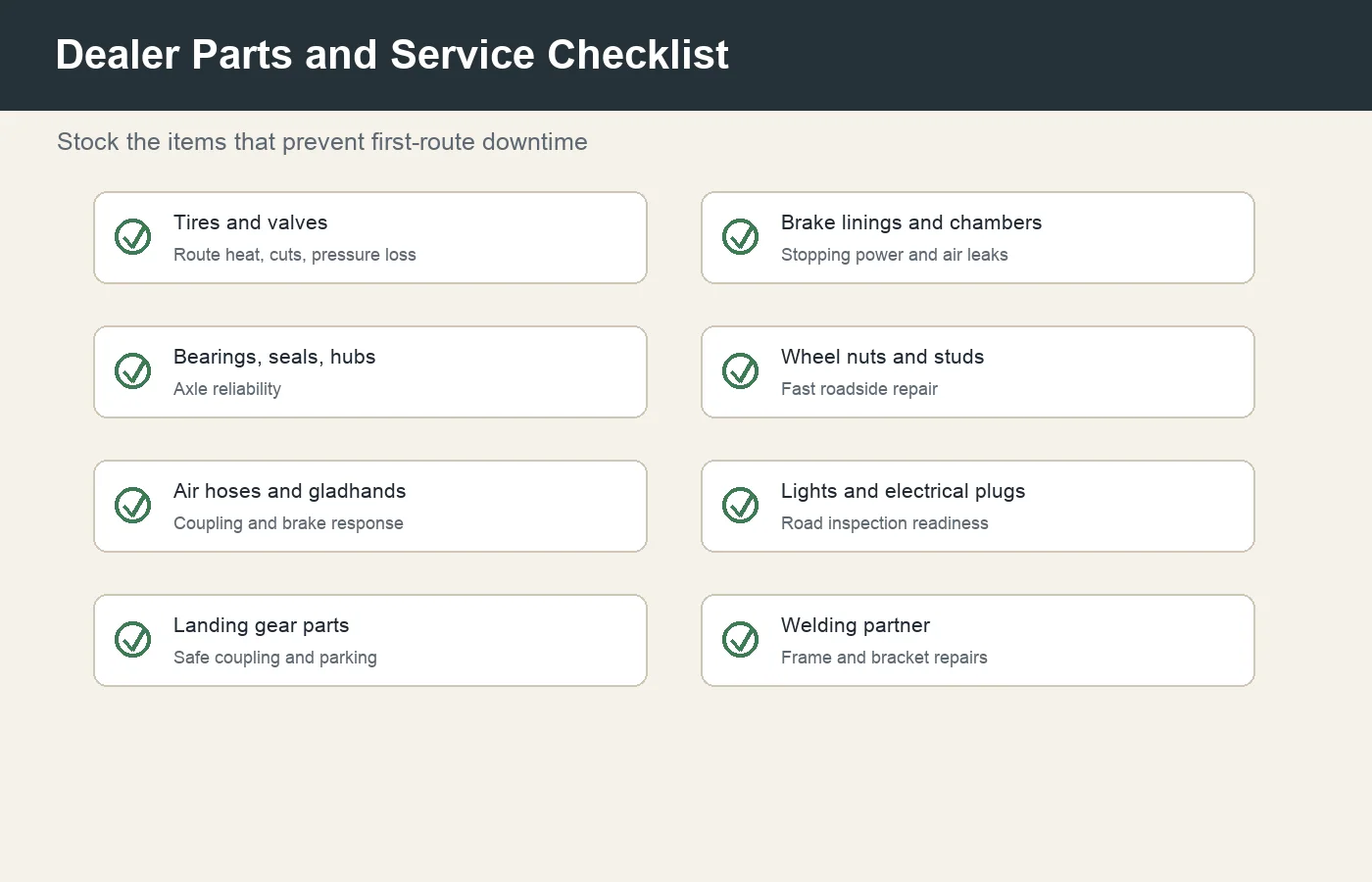
The guide on trailer axle spare parts in Africa is useful for stocking decisions. The guides on trailer brake system maintenance and trailer tire selection for African roads can help your service team speak with buyers in a more useful way.
Step 7: Create a Simple Sales Process
A dealer does not need a complex system at the start. It needs discipline.
Use this inquiry flow:
1. Record buyer name, company, country, and WhatsApp. 2. Ask cargo type, route, payload, and tractor status. 3. Send the best-fit model, not every model. 4. Explain key specification choices. 5. Share real photos, drawings, and delivery references. 6. Give EXW, FOB, or CIF logic clearly. 7. Ask whether the buyer has a broker or needs document support. 8. Follow up with a clear next step.
Do not send only "best price." A dealer becomes valuable when it reduces buyer uncertainty.
Step 8: Use Sample Units and Demo Media
A dealer can sell without a large yard at first, but it still needs proof. Use sample units, factory inspection media, delivery videos, and customer use photos.
Good sales media includes:
- Full side view.
- Front and rear view.
- Main beam and crossmember photos.
- Axle and suspension close-ups.
- Brake and air-line photos.
- Tire brand and size.
- Landing gear.
- Kingpin and upper plate.
- Ramp, valve, tank, or special fittings when relevant.
- Loading and shipment photos.
Avoid photos with unclear logos, messy text, or unrelated products. A dealer must look organized.
Step 9: Price Your Dealer Margin Correctly
Dealer margin should cover more than a phone call. It should cover sales time, customer education, local support, document checking, inspection coordination, risk, warranty handling, and after-sales.
Do not compete only on the lowest margin. If the dealer cannot support the buyer after delivery, the cheap sale can damage the brand.
Use a simple price sheet:
| Cost item | Why it matters |
|---|---|
| Factory price | Base unit cost |
| Freight and port cost | Moves the unit to the destination |
| Local taxes and broker fee | Needed for release |
| Spare parts kit | Reduces first-service risk |
| Inspection and media cost | Builds trust |
| Dealer margin | Pays for service and risk |
For freight planning, read CIF vs FOB trailer shipping to Africa and trailer shipping time from China to Africa. For finance pressure, read trailer financing options in Africa.
Common Mistakes New Dealers Make
Selling a product they do not understand
If you cannot explain axle, brake, tire, suspension, kingpin, and route fit, buyers will not trust your quote.
Copying another dealer's price
Your cost, port, buyer support, and warranty risk may be different.
Choosing too many models
Too many products weaken focus. Start with a small mix and learn the market.
Ignoring local repair support
A dealer without service support becomes a one-time seller.
Promising exact customs cost without local review
Customs cost depends on country rules and classification. Let the broker verify.
Dealer Startup Checklist
| Area | Minimum action before launch |
|---|---|
| Market | Choose one country, route, or buyer group |
| Product | Select 3 to 5 main models |
| Supplier | Verify factory, drawings, delivery proof, and warranty |
| Documents | Prepare product description and photos for broker review |
| Pricing | Build landed-cost template |
| Parts | Stock or source fast-moving parts |
| Service | Find tire, brake, welding, and inspection partners |
| Sales | Use inquiry form, follow-up sheet, and product media |
FAQ
How much money do I need to become a trailer dealer?
It depends on your model. You can start as a sales and sourcing dealer with lower capital, or you can buy sample units and keep stock. Stock needs more cash but can build trust faster.
Which trailer should a new African dealer sell first?
A 3-axle flatbed semi-trailer is often a practical first model because it fits many cargo types. Add lowbed, tanker, or tractor trucks only when your buyer group needs them.
Do I need a warehouse?
You do not always need a large warehouse at first. But you do need a place for sample units, inspection, spare parts, and customer visits if you want to build trust.
How do I find buyers?
Use local fleet visits, WhatsApp, Google search content, Facebook, YouTube product videos, tender monitoring, workshop networks, and referrals from clearing agents or transport managers.
Related Reading
- How to import trucks and trailers to Africa
- How to verify a Chinese trailer manufacturer
- Trailer financing options in Africa
- Trailer axle spare parts in Africa
Final Dealer Checklist
Becoming a trailer dealer in Africa is a route, product, supplier, and service business. Start focused. Verify suppliers. Build a simple product mix. Prepare landed-cost support. Stock key parts. Then use every delivery as proof for the next buyer.