
Direct answer: To verify a Chinese trailer manufacturer, check the legal company name, factory address, business registration, export ability, product drawings, past shipment proof, workshop reality, quality-control process, payment terms, and loading documents. Do this before paying a deposit. A real factory should be able to show consistent company details, production photos, technical drawings, inspection records, and export documents that match the contract.
For African trailer buyers, verification is not only about avoiding fraud. It is also about avoiding the wrong specification, weak frame welding, bad paint, unavailable spare parts, unclear warranty, and document mismatch at the port. A supplier can have a nice catalog and still be a trading company with little control over the trailer build.
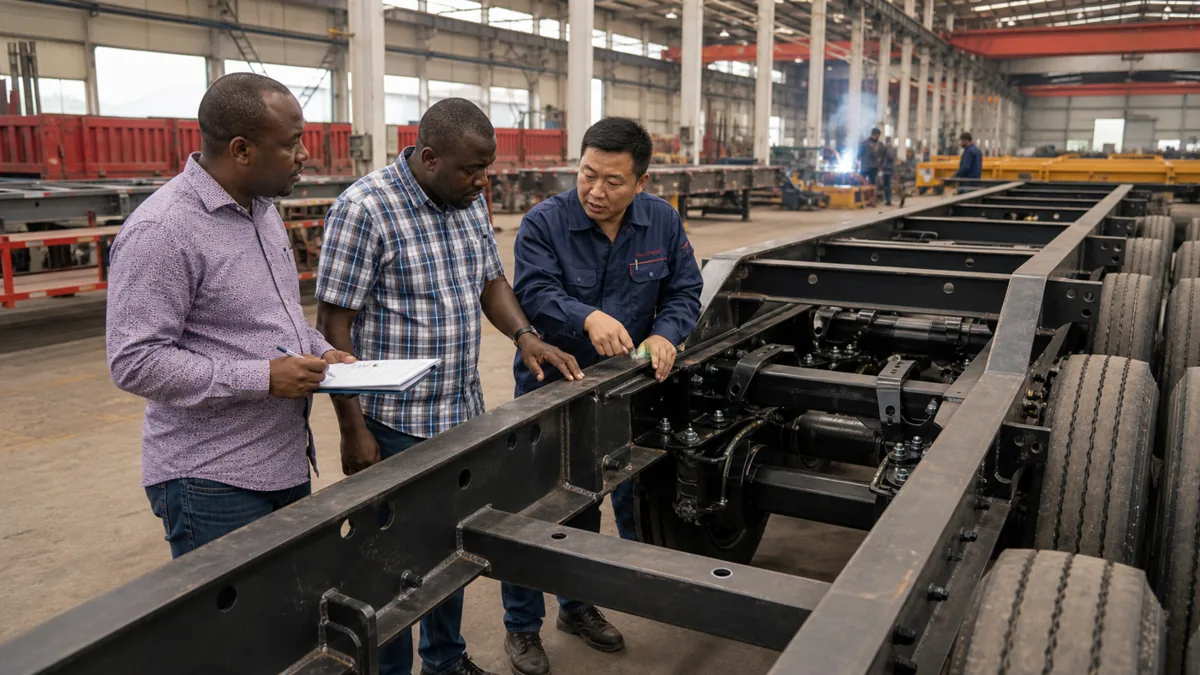
Quick Buyer Decisions
- Verify the legal company before discussing final payment.
- Make the quotation use the same company name as the contract, invoice, and export documents.
- Ask whether the supplier is the real factory, a sales office, or a trading company.
- Request production photos at frame, axle, brake, paint, and loading stages.
- Check technical drawings before production starts.
- Do not accept vague payload claims without axle, tire, suspension, frame, and route details.
- Keep every version of the quotation, drawing, invoice, and payment record.
- Use a third-party inspection or video audit when order value is high.
Step 1: Confirm the Legal Identity
Start with the legal company name in Chinese and English. The name should be consistent across the quotation, proforma invoice, bank account, contract, export documents, and bill of lading draft. If the names are different, ask why before paying.
China's market regulation system is supervised by official government bodies. The State Administration for Market Regulation, accessed June 20, 2026 is the national market regulation authority. A buyer should use official registry information, the supplier's business license, and a local verification service when a large order is involved.
Do not treat a business license as enough proof by itself. A registered company may still be a trader, a small workshop, or a broker. The license tells you that the company exists. It does not prove that the company can build your trailer correctly.
Use this first check:
| Item | What to ask for | What to compare |
|---|---|---|
| Legal company name | Business license and invoice name | Contract, bank account, and export files |
| Registered address | License address | Factory address and video call location |
| Business scope | Trailer, vehicle, machinery, or trading scope | Product type you are buying |
| Bank account | Beneficiary name | Same company as the contract |
| Contact person | Sales name and company email | Same company domain or verified contact |
Step 2: Check Export Ability and Document Control
A trailer export order needs more than production. It also needs correct export documents. The commercial invoice, packing list, bill of lading, chassis number or VIN reference, product description, HS code discussion, and consignee details must be consistent.
The China Customs English portal, accessed June 20, 2026 is the official English-language entry point for China customs information. Trailer buyers do not need to manage China export clearance by themselves, but they should make sure the shipper, exporter, and documents are clear before the trailer leaves China.
Ask these questions:
- Who will appear as exporter on the shipping documents?
- Will the invoice company match the payment beneficiary?
- Who prepares the packing list and bill of lading draft?
- Can the supplier show redacted examples of past export documents?
- Can the supplier provide loading photos and a condition report?
- Who is responsible if the document name, consignee, or chassis number is wrong?
If the order is going to West Africa, East Africa, or Southern Africa, document mismatch can create delays after arrival. For shipping term control, read CIF vs FOB Trailer Shipping to Africa. It explains why buyers should know who controls the freight booking and document flow.
Step 3: Confirm Whether It Is a Factory or a Trader
A trader is not always bad. Some traders are useful because they coordinate products, documents, and communication. The problem is hidden identity. If a supplier says it is the manufacturer but cannot show the workshop, production line, drawings, or factory inspection process, the buyer has a risk.
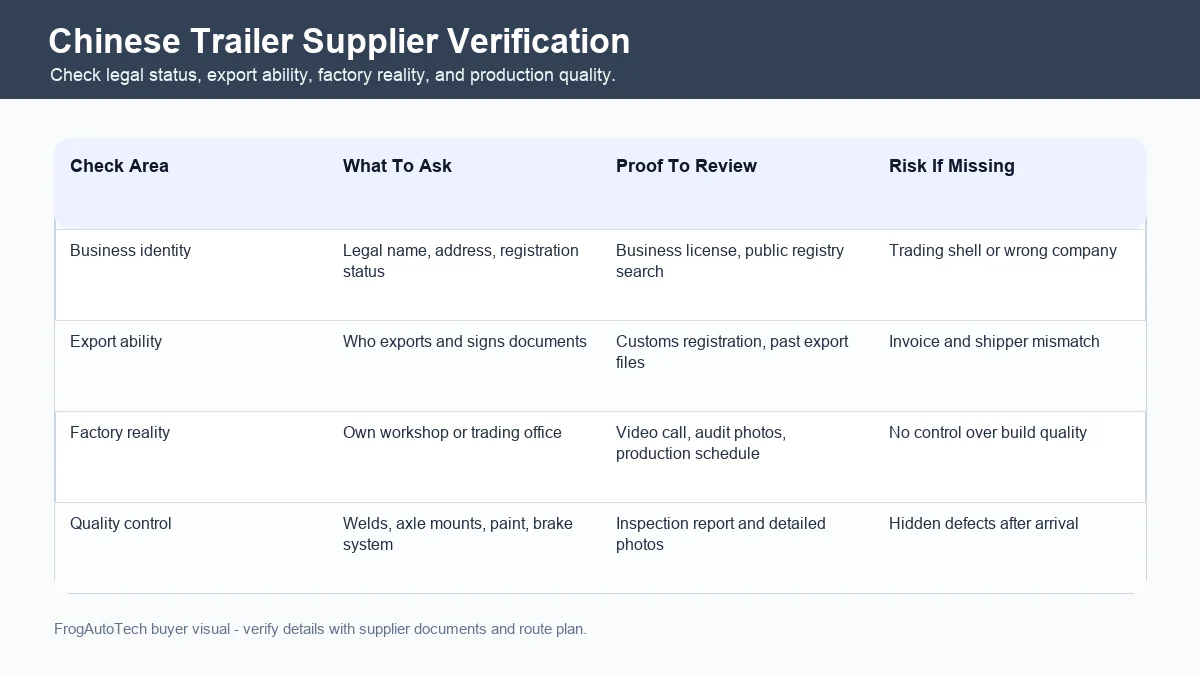
Use a simple video audit:
| Audit point | What to look for | Warning sign |
|---|---|---|
| Factory gate | Company name, yard, trailers, workers | Only office video, no workshop |
| Steel cutting and welding | Frame rails, crossmembers, weld areas | No production activity |
| Axle and suspension area | Hangers, leaf springs, airbags, brackets | Cannot explain axle brand or layout |
| Paint area | Primer, topcoat, drying area | Fresh paint hides poor preparation |
| Finished trailer yard | Similar models ready for shipment | Only unrelated products |
| Loading area | Wheel chocks, lashing, port transport | No export loading process |
Ask the person on video to walk from the office to the yard and workshop. Ask them to show the current date on a phone, then show the trailer frame, axle mounts, landing gear area, kingpin plate, and tires. This is simple, but it quickly separates real factory access from catalog-only selling.
Step 4: Verify Technical Specs Before Production
Many trailer disputes begin because the buyer and supplier did not define the same specification. A "60 ton lowbed" can mean different frame thickness, axle brand, tire size, deck length, ramp type, suspension, brake system, and payload condition.
Before deposit payment, request a specification sheet with:
- Trailer type and model.
- Overall length, width, and deck height.
- Payload and design condition.
- Axle quantity, axle brand, and axle load.
- Tire size, tire quantity, and spare tire plan.
- Suspension type and spring details.
- Brake system and air line layout.
- Kingpin size.
- Landing gear capacity.
- Main beam material and thickness.
- Floor plate thickness.
- Ramp type and hydraulic system if used.
- Paint system and color.
- Tool box, spare parts, and optional parts.
If the trailer is for rough roads, read Trailer Axle Load Capacity for African Roads before approving the drawing. If suspension choice is unclear, use How to Choose Trailer Suspension for the African Market as a checklist.
For heavy machinery transport, compare your requested spec with a real product page such as the 13 m Heavy-Duty Low Bed Semi Trailer with Hydraulic Ramps. The drawings, ramp type, axle layout, and ground clearance should match the job, not only the headline payload.
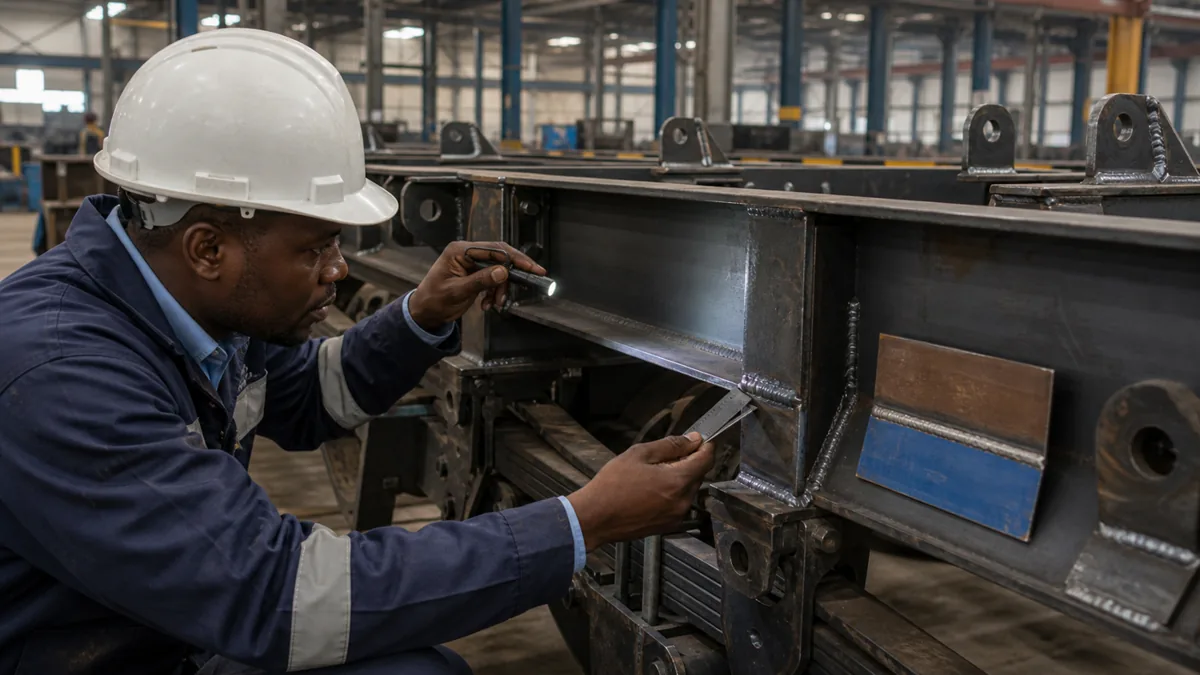
Step 5: Check Quality Control, Not Only Certificates
Certificates can help, but they are not a full factory audit. The ISO 9000 family page, accessed June 20, 2026 explains that ISO 9001 is a quality management standard. For a trailer buyer, an ISO certificate may show that the company has a quality system, but it does not prove that your specific trailer has the right steel, welds, axles, tires, or brake parts.
Ask for process evidence:
| Stage | Photo or record to request | What it proves |
|---|---|---|
| Material preparation | Main beam and crossmember photos | Steel and frame layout match order |
| Welding | Welds around frame, suspension hangers, ramp area | Critical joints were built and inspected |
| Axle installation | Axle brand, hub, brake chamber, spring seat | Running gear matches spec |
| Paint | Sanding, primer, topcoat, drying | Paint was not only sprayed over rust or oil |
| Electrical and brake system | Air lines, lights, connectors, ABS if included | Road-safety parts are installed correctly |
| Final inspection | Full trailer photos and checklist | The finished unit matches the contract |
| Loading | Port loading photos and lashing photos | Condition before shipment is recorded |
Need help checking a supplier quotation?
Send the trailer drawing, payload, axle plan, tire size, route, and supplier document list before paying the deposit.
Step 6: Control Payment Risk
Payment terms should match verification progress. A common structure is deposit before production and balance before shipment, but the exact split depends on the supplier, order value, and relationship. Do not send a large payment to a company name that does not match the contract.
Use these rules:
- Pay only to the company named in the contract unless there is a written and verified reason.
- Make the contract list the trailer spec, delivery term, warranty, and production timeline.
- Do not release final balance before final inspection photos or third-party inspection.
- Keep bank receipts and supplier confirmations.
- Make the bill of lading draft part of the final document check.
- If the supplier changes bank account, stop and re-verify by a separate communication channel.
For Nigeria buyers, the article on Importing Semi-Trailer from China to Nigeria shows why document control matters before Lagos port clearance. The same logic applies to many African ports.
Step 7: Follow a Simple Audit Flow
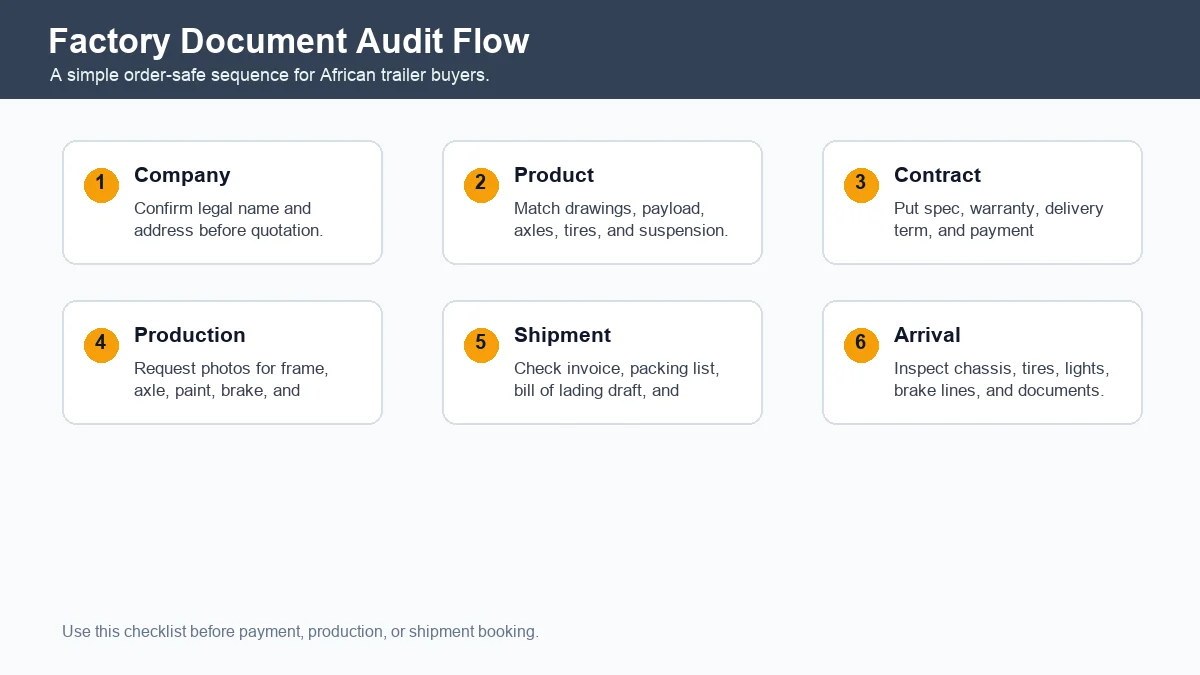
Use this sequence:
1. Confirm legal company name. 2. Check factory access and product category. 3. Review the quotation and technical drawing. 4. Confirm export document responsibility. 5. Agree on payment terms and inspection points. 6. Request production photos at key stages. 7. Check final photos and loading records. 8. Review the bill of lading draft before shipment. 9. Inspect the trailer after arrival.
This flow is simple, but it protects the buyer from most avoidable problems: wrong company, wrong spec, poor build, unclear documents, and no proof before shipment.
Red Flags
Be careful if you see these signs:
- The supplier refuses to show a business license.
- The bank beneficiary is a different company without explanation.
- The factory video shows only an office or showroom.
- The supplier cannot explain axle brand, tire size, or suspension.
- The quotation says only "heavy duty" without dimensions and parts.
- The supplier offers a very low price but no production photos.
- The supplier pushes urgent payment before document review.
- The contract does not mention inspection, warranty, or delivery term.
- The same product photos appear on many unrelated websites.
FAQ
Is a trading company always unsafe?
No. A good trading company can be helpful if it is honest about its role and controls the supply chain well. The risk is when a trader claims to be the factory but cannot show production access or technical control.
Is ISO 9001 enough to verify a trailer factory?
No. ISO 9001 can support the quality-system story, but it does not replace product inspection. You still need drawings, production photos, weld checks, axle checks, brake checks, and loading proof.
Should I use a third-party inspection company?
Use one when the order value is high, the supplier is new, the trailer is customized, or the route is demanding. A third-party inspection can check finished condition, but it should not replace early drawing review.
What is the most important document before shipment?
There is no single document. The important point is consistency. The company name, invoice, packing list, bill of lading draft, chassis number, product description, and consignee details should match.
Final Buyer Advice
A Chinese trailer manufacturer should be verified in layers. First check the company. Then check factory reality. Then check technical drawings. Then check production quality. Then check export documents and loading proof.
If one layer is weak, slow down before payment. The safest order is not the cheapest quotation. It is the order where the buyer can verify who builds the trailer, what will be built, how it will be inspected, and how it will be shipped.