
Importing Semi-Trailer from China to Nigeria: 2026 Buyer Guide for Documents, Lagos Port Clearance, and Landed Cost
> Summary: Importing semi-trailer from China to Nigeria is not difficult if the buyer controls three things before shipment: the trailer specification, the Nigerian import documents, and the real landed-cost estimate. This guide explains how to move from supplier quotation to Lagos port clearance without relying only on the FOB price.
Best for: Nigerian logistics companies, construction contractors, trailer dealers, mining transport buyers, and procurement managers buying semi-trailers from Chinese manufacturers.
What you can decide after reading: whether a supplier is ready, which shipping mode to discuss, what documents to prepare, what costs to ask your clearing agent to estimate, and what questions to send before paying a deposit.
—
Quick Answer: What Should a Nigerian Buyer Do First?
If you are importing semi-trailer from China to Nigeria, start by confirming the trailer specification and Nigerian clearance path before you negotiate final price. The safest order is: choose the trailer type, confirm axle/suspension/brake details, get a proforma invoice and technical drawing, ask your Nigerian clearing agent to verify HS classification and import requirements, open Form M where applicable, align the shipping mode with the trailer dimensions, and only then release the production deposit.
Many buyers do the opposite: they compare two FOB prices first, then discover that the shipping method, documents, terminal charges, or clearing requirements were never confirmed. For a first shipment, treat the semi-trailer like a project with five workstreams:
- Trailer specification and Nigerian road fit
- Supplier verification and production evidence
- Import documentation and compliance checks
- China-to-Nigeria shipping method
- Lagos port clearance, local delivery, and after-sales support
If you already know the trailer type, you can compare semi-trailer configurations for Nigeria roads and prepare a more accurate quote request before talking to your forwarder.
Step 1: Decide the Trailer Spec Before You Ask for the Final Price
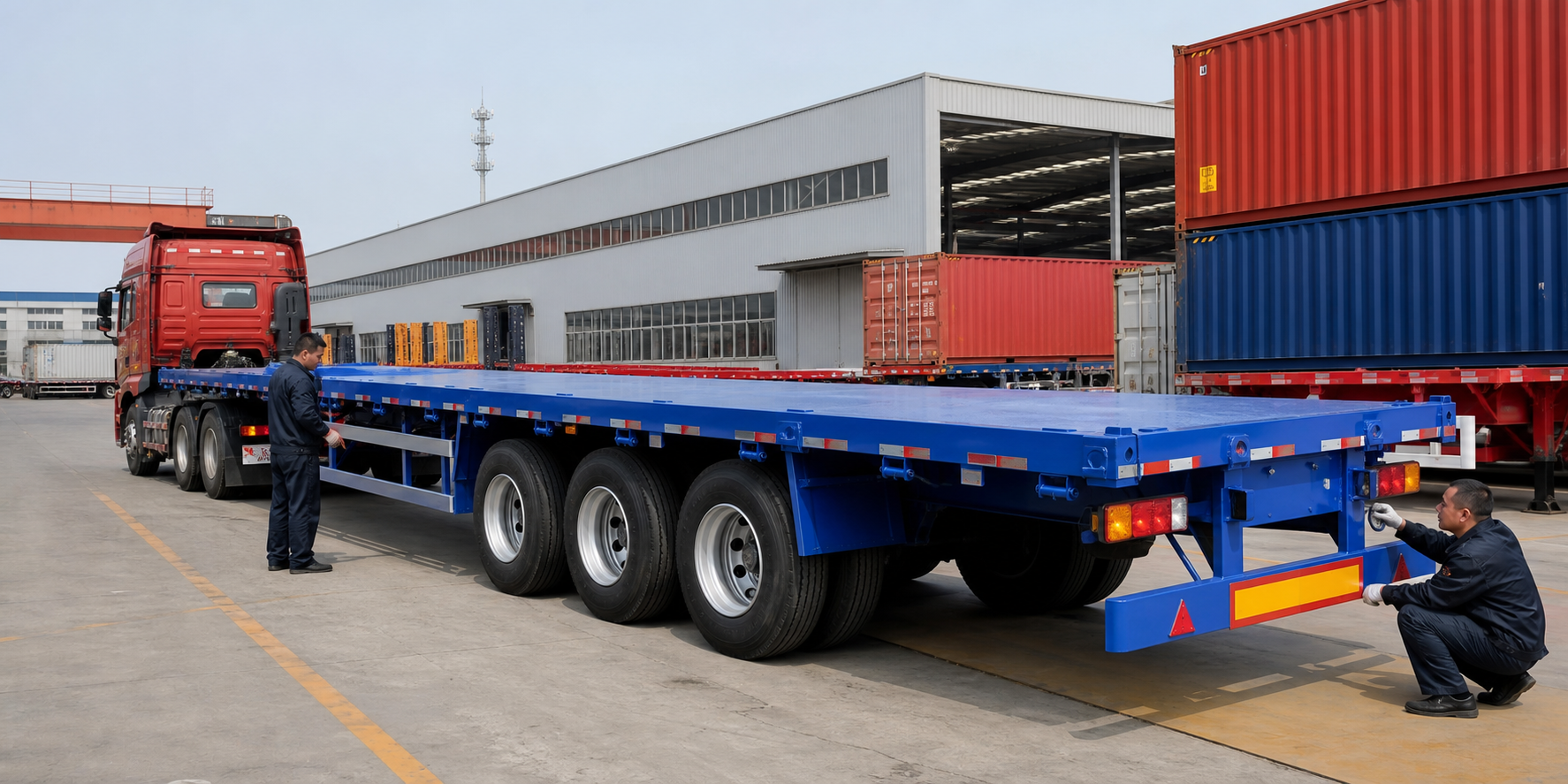
The first mistake is asking for “semi-trailer price” without telling the supplier the work the trailer will actually do. A semi-trailer for Lagos container movement is not the same as a flatbed for construction steel, a lowbed for excavators, or a tipper trailer for quarry work. Start with average payload, maximum payload, loading method, route condition, distance per trip, rainy-season road condition, and towing truck model. The supplier needs this information to recommend axle count, suspension, tire size, kingpin height, landing gear, brake system, frame material, and paint system.
Before you compare price, ask for the general drawing, axle/suspension/brake details, tire specification, kingpin and fifth-wheel height recommendation, beam material, paint process, shipment loading plan, warranty, and spare-parts list.
The goal is not to make the buyer an engineer. The goal is to stop price quotes from hiding different specifications. Two suppliers may both quote a “3 axle flatbed semi-trailer,” but one may use a lighter beam, cheaper suspension, thinner paint, or a shipping method that requires local reassembly.
Step 2: Check the Nigerian Import Workflow Before Shipment
Nigeria has an import workflow that a serious buyer should understand before the trailer leaves China. The Nigerian Ports Authority import guide says the import process involves steps such as company registration, FIRS tax registration/TIN, an Authorized Dealer Bank, Form M, PAAR, shipping company manifest submission, terminal handling, and final delivery processes Nigerian Ports Authority Import & Export Guidelines, 2024.
That does not mean every importer personally handles every step. Many buyers use a bank, a clearing agent, and a freight forwarder. But you still need to know what each party is responsible for. If nobody owns a step, the problem usually appears after arrival, when storage and demurrage start to run.
The Nigeria Trade Portal is also important because it lists trade tools and e-document links, including Form M, PAAR Consignment, Tariff Search, Trader’s Guide, and Customs Exchange Rate Nigeria Trade Portal, accessed June 2026. A buyer does not need to become a customs specialist, but the portal tells you which digital processes your clearing agent and bank may reference.
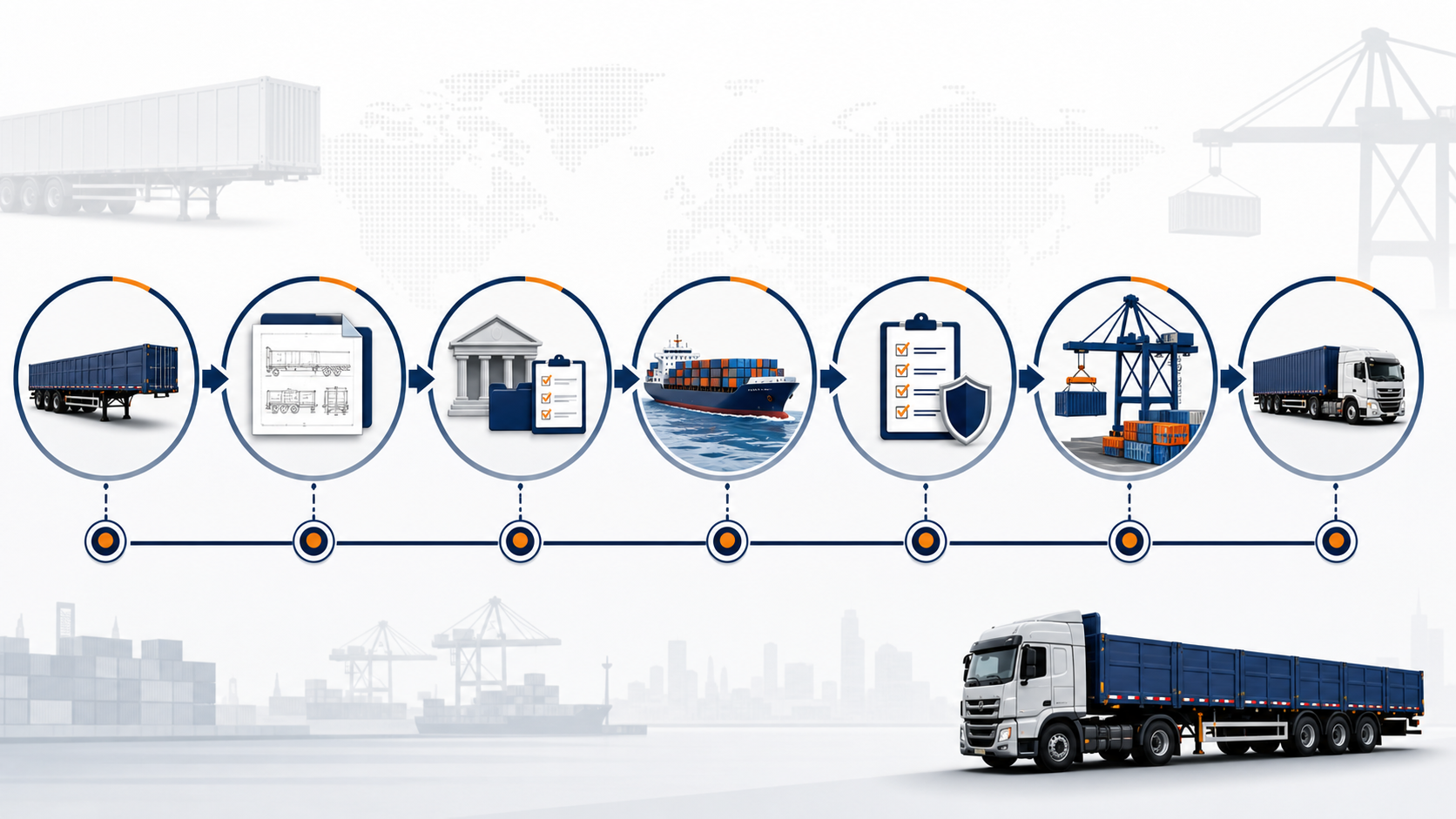
Here is the practical import flow a buyer should map before paying a deposit:
| Stage | What happens | Who should lead | What the buyer should check |
|---|---|---|---|
| 1. Quote and spec | Supplier prepares technical quote, drawing, proforma invoice | Buyer and supplier | Trailer type, payload, dimensions, axle/suspension/brake details |
| 2. Import planning | Nigerian side checks HS classification, Form M, PAAR path, SONCAP if applicable | Importer, bank, clearing agent | Whether documents match the exact trailer and shipment mode |
| 3. Production | Supplier builds trailer and shares progress evidence | Supplier | Photos/videos, inspection checklist, serial/VIN/chassis numbers where applicable |
| 4. Pre-shipment | Forwarder confirms shipping mode, booking, loading method, insurance | Supplier and forwarder | RoRo/breakbulk/flat-rack/SKD cost and terminal acceptance |
| 5. Arrival and clearance | Manifest, bill of lading, terminal handling, customs/port clearance | Shipping line, terminal, clearing agent | PAAR, duty/tax estimate, terminal charges, release timeline |
| 6. Delivery | Trailer leaves port and moves to buyer’s yard or worksite | Importer, clearing agent, local transporter | Temporary movement plan, roadworthiness, local registration requirements |
This table is not a substitute for professional customs advice. It is a control sheet. Use it to ask better questions and to make sure your supplier, forwarder, and clearing agent are working from the same shipment details.
Step 3: Prepare the Document Pack Early
The document pack is where many cheap imports become slow imports. For a semi-trailer, documents must connect three realities: what the supplier is selling, what the forwarder is shipping, and what Nigerian customs and port processes will see on arrival.
At minimum, discuss these documents with your supplier and clearing agent:
| Document | Why it matters | Who usually provides it | Common mistake |
|---|---|---|---|
| Proforma invoice | Used for quotation, bank process, and import planning | Supplier | Description too vague, such as “trailer” without model/spec |
| Commercial invoice | Final value and shipment details | Supplier | Different value or description from Form M/PAAR planning |
| Packing list | Shows quantity, dimensions, accessories, spare parts | Supplier | Missing spare parts or loose accessories |
| Technical drawing/spec sheet | Helps classification, shipping plan, and buyer acceptance | Supplier | Dimensions not matching loading method |
| Bill of lading | Shipping contract and cargo release document | Shipping line/forwarder | Consignee and notify party errors |
| Certificate of origin | Supports origin declaration | Supplier/chamber or relevant issuer | Not requested before shipment |
| Insurance certificate | Protects cargo during transit depending on Incoterms | Buyer/seller/forwarder | Assuming CIF always covers every risk |
| Product/conformity documents | May be needed if goods fall under regulated requirements | Supplier/SONCAP IAF | Checking after the trailer has shipped |
The NPA import procedure specifically references Form M, PAAR, insurance certificate, proforma invoice, Product Certificate where regulated by SON, final invoice, bill of lading/airway bill, and packing list in the import flow Nigerian Ports Authority Import & Export Guidelines, 2024. Use that as your reminder: the Nigerian side needs documents before arrival, not after the trailer is already waiting in Lagos.
One practical habit helps: ask your supplier to put the same clear product description everywhere. “3 Axle Flatbed Semi-Trailer, 40ft platform, mechanical suspension, 13-ton axles, for general cargo transport” is much better than “vehicle trailer.”
Step 4: Do Not Guess Import Duty – Verify HS Code and Current Charges
Many buyers ask, “What is the import duty for a semi-trailer in Nigeria?” The honest answer is: verify the HS classification and current charges for your exact shipment before quoting landed cost to your boss or customer.
Nigeria Customs Service has a CET Tariff page that says the tariff sections and chapters can be consulted online or downloaded, and that the tariff search engine can query a chapter, commodity, or keyword Nigeria Customs Service CET Tariff, accessed June 2026. The Nigeria Trade Portal also lists tariff search and customs exchange-rate tools Nigeria Trade Portal, accessed June 2026. Use these official tools with a licensed clearing agent instead of copying a rate from a forum or old WhatsApp message.
For semi-trailers, the classification often points toward HS heading 8716, but do not treat that as a final legal answer for every shipment. The exact classification can be affected by product type, whether the unit is new or used, whether it is shipped complete or in parts, and how the documents describe it. A flatbed semi-trailer, skeletal trailer, lowbed trailer, tipper trailer, tank trailer, and spare parts shipment may not all be treated the same way in practice.
When estimating landed cost, ask your clearing agent to separate the following items:
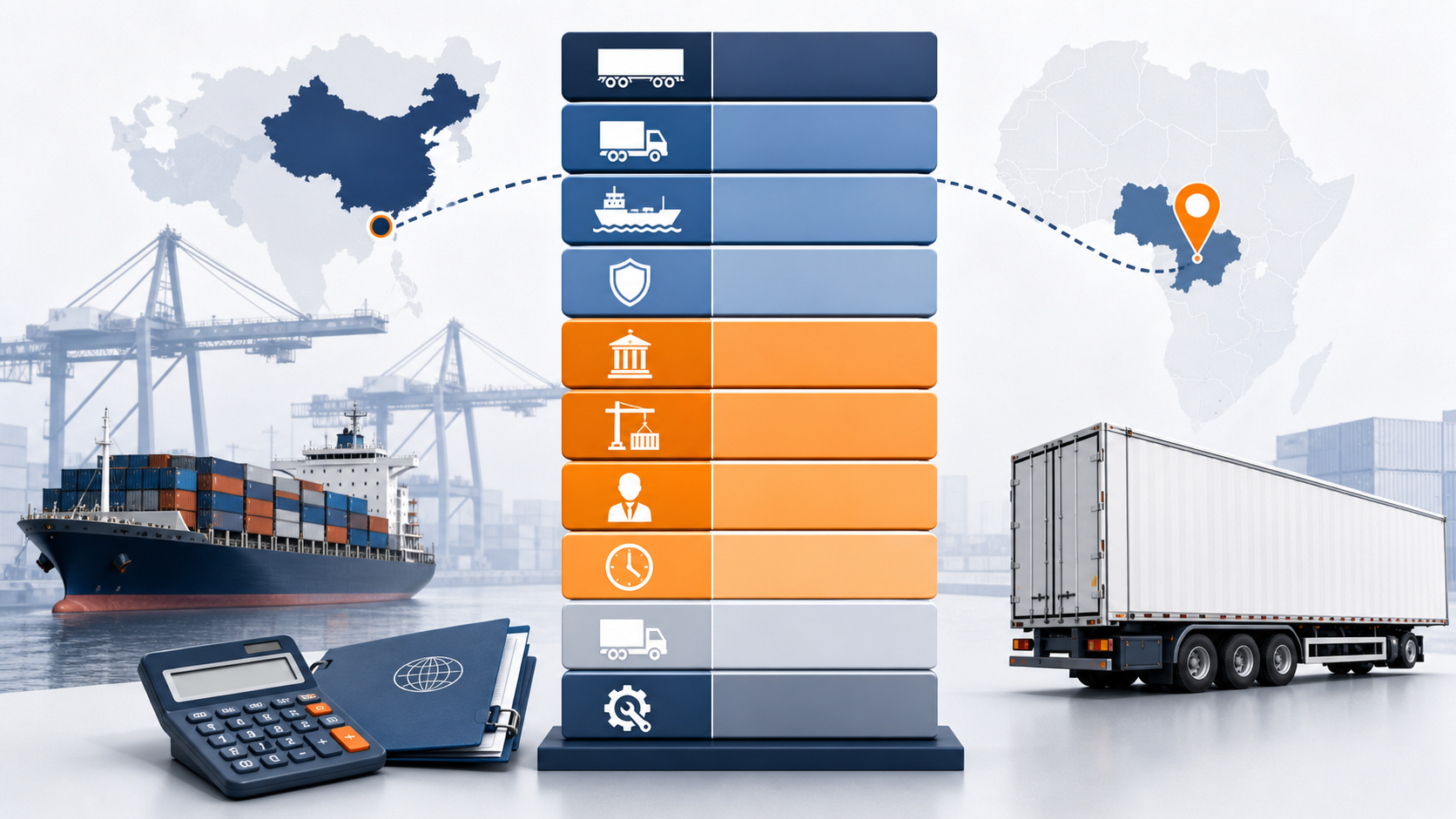
| Cost item | What to ask | Why it matters |
|---|---|---|
| FOB trailer price | Is the quote factory, port, or FOB? | Many quotes exclude inland China delivery or port charges |
| China inland transport | Is factory far from loading port? | Oversize trailers can cost more to move domestically |
| Ocean freight | Which mode: RoRo, breakbulk, flat-rack, or SKD/container? | The shipping method changes freight and handling cost |
| Marine insurance | What risks and value are covered? | CIF is not always enough for buyer comfort |
| Customs duty/tax/levies | What HS code and exchange rate were used? | Wrong assumptions can break the landed-cost budget |
| Terminal handling and port charges | Which terminal and cargo type? | Storage, handling, and port charges differ |
| Clearing agent fee | What is included? | Some quotes exclude inspection, local transport, or extra documentation |
| Demurrage/storage buffer | How many free days? | Delays can quickly erase a low FOB price |
| Inland haulage | From Lagos/Tin Can/Apapa to final yard | A trailer may need towing, escort, or local movement permits |
| Local registration/road compliance | What is needed before operation? | Import clearance is not the same as road operation readiness |
There is also a used-equipment caution. The NCS import prohibition list includes “used motor vehicles above twelve (12) years from the year of manufacture” under HS 8703 NCS Import Prohibition List, accessed June 2026. This line is about used motor vehicles under that HS scope, not a simple blanket statement for every trailer under every classification. Still, it is a warning: if you plan to import a used semi-trailer, check classification, age, condition, and admissibility with your clearing agent before paying.
If you want a practical landed-cost discussion, request a landed-cost discussion for your Nigeria route and include the trailer type, port, preferred Incoterm, and final delivery city.
Step 5: Check SONCAP and Product Compliance Before Loading
SONCAP can become confusing because buyers often hear about it late. The Standards Organisation of Nigeria explains that SONCAP is a pre-shipment verification of conformity process used to verify that products imported into Nigeria conform to applicable Nigerian Industrial Standards or approved equivalents before shipment SONCAP Service, accessed June 2026. The same page explains that goods subject to SONCAP arriving at a Nigerian port must be accompanied by a SONCAP Certificate, and that Product Certificate, Certificate of Conformity, and SONCAP Certificate can be part of the compliance process for regulated goods.
For a semi-trailer shipment, do not assume “needed” or “not needed” from a casual message. Ask your clearing agent, bank, and supplier to confirm the current requirement for the exact product description and shipment structure. If SONCAP applies, the process may require product documentation, inspection, testing, and certificate steps before shipment.
Ask the supplier whether it has exported this trailer type to Nigeria before, which SONCAP route or IAF was used if applicable, whether the invoice and packing list can match the Form M/PAAR plan, and who coordinates inspection if it is needed. A manufacturer with export document experience can save time after production. A low-price trader who cannot prepare proper documents may push cost onto the buyer later.
Step 6: Choose the Shipping Mode That Fits the Trailer
Shipping a semi-trailer is not the same as shipping small parts. The cargo is long, heavy, and sometimes over-dimension. The best method depends on trailer type, dimensions, whether it can roll, loading port, destination terminal, carrier schedule, and cost.
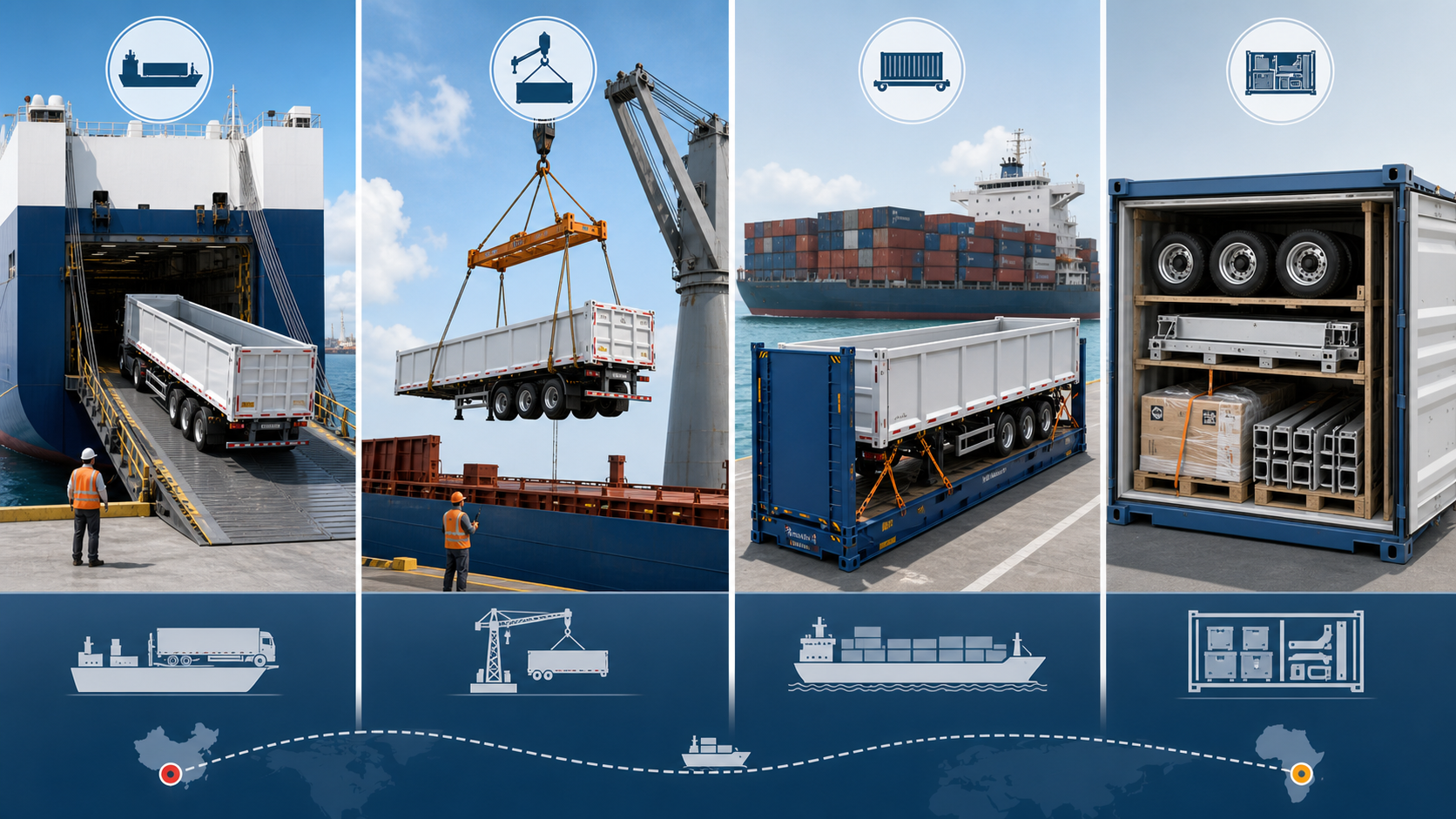
The four common options are:
| Shipping mode | When it fits | Buyer advantage | Main risk to check |
|---|---|---|---|
| RoRo | Complete trailer can roll or be towed and carrier accepts it | Less lifting, often simpler for wheeled cargo | Schedule availability and destination terminal acceptance |
| Breakbulk | Oversize complete trailer or heavy equipment cargo | Flexible for large units | More handling points, lashing quality, port handling charges |
| Flat-rack | Trailer or parts can be secured on special container equipment | Container-network access | Over-width/over-length surcharges and lifting plan |
| SKD/CKD/container loading | Trailer can be partially disassembled | May reduce volume or shipping constraints | Reassembly quality, missing parts, local labor, warranty disputes |
Nigeria’s Lagos port system gives buyers several port/terminal considerations. The NPA describes Lagos Port Complex in Apapa as Nigeria’s earliest and largest port, with road, water, and rail intermodal connection and an 8-meter gate that gives it an advantage for oversized cargo handling NPA Lagos Port Complex, 2025. NPA’s Tin Can Island Port page says the port handles diversified cargoes including dry/wet bulk, containerized cargo, and RoRo services, and that the port handles vessels ranging from 100m to 260m NPA Tin Can Island Port, 2025.
These facts do not mean every trailer should go to the same terminal. They mean the buyer should ask the forwarder which terminal will receive the cargo, whether the terminal accepts the proposed dimensions, whether the cargo is RoRo, breakbulk, flat-rack, or SKD, how many free storage days are included, and which documents must arrive before the vessel reaches Nigeria.
For planning, many China-to-Nigeria ocean shipments need several weeks on the water, and the door-to-yard timeline can be longer once production, China domestic trucking, port loading, customs clearance, terminal release, and inland movement are included. Do not sell your customer a fixed delivery date based only on a verbal freight quote.
Step 7: Assign Responsibilities Before the Vessel Arrives
Lagos clearance delays often come from unclear responsibility. The supplier thinks the forwarder will handle something. The forwarder thinks the clearing agent has the document. The clearing agent thinks the buyer already approved a cost. Meanwhile, the cargo is at the terminal.
Assign each task before shipment. The supplier leads the drawing, invoice, packing list, inspection evidence, and loading support. The forwarder leads booking, shipping mode, bill of lading details, and sailing updates. The clearing agent leads classification advice, Form M/PAAR support, SONCAP advice where applicable, arrival clearance, and terminal-release coordination. The buyer must approve the description, value, shipping cost, clearance budget, and inland movement plan.
Review the bill of lading before it is finalized: consignee, notify party, cargo description, quantity, marks, and destination. Also prepare physical pickup. A semi-trailer may need a tractor head, driver, insurance, and a basic inspection before it leaves the terminal.
Step 8: Inspect the Trailer Before Shipment and Again After Arrival
A factory inspection is cheaper than an argument after arrival. You do not always need to fly to China, but you should request enough evidence to prove the trailer is being built to the agreed specification: production ID, main beam photos before painting, axle/suspension/landing gear/tire/brake photos, welding and reinforcement photos, paint process photos, walkaround video, loading video, key measurements, and final accessory list.
For Nigerian operating conditions, pay special attention to suspension, tire quality, brake system, kingpin, landing gear, frame reinforcement, and paint. Wet-season roads, overloaded cargo practices, and rough construction access roads punish weak components quickly. After arrival, inspect visible transport damage, accessories, spare parts, tires, brake lines, lights, landing gear, paint scratches, and hydraulic or locking systems before accepting local handover.
Step 9: Avoid the Seven Common Mistakes
The same import problems repeat. Most are preventable:
- Comparing only FOB price instead of landed cost
- Using a vague product description such as “trailer”
- Checking HS classification and duty assumptions after production
- Assuming every supplier understands Nigeria documents
- Choosing a shipping mode before terminal acceptance is confirmed
- Ignoring storage, demurrage, and free-time limits
- Forgetting spare parts, warranty scope, and local maintenance needs
Practical Checklist Before You Pay the Deposit
Use this list before sending money:
- [ ] I know the exact trailer type, payload, route, road condition, and towing truck compatibility.
- [ ] The supplier quote includes drawing, dimensions, axle/suspension/brake/tire details, paint system, warranty, and spare parts.
- [ ] My clearing agent has checked likely HS classification and current duty/tax/levy assumptions through official tools.
- [ ] My bank/import process team has advised the Form M and PAAR path.
- [ ] SONCAP applicability has been checked for the exact product and shipment.
- [ ] The forwarder has confirmed shipping mode, port, terminal, sailing estimate, free time, and cargo acceptance.
- [ ] I know who pays for China local charges, ocean freight, insurance, destination terminal, clearance, storage, demurrage, and inland transport.
- [ ] I have a plan for towing the trailer from the port to my yard and for first-service spare parts.
If you cannot tick most of these boxes, you are not ready to judge whether the quote is cheap or expensive.
Frequently Asked Questions
What documents are needed for importing semi-trailer from China to Nigeria?
Common documents include proforma invoice, commercial invoice, packing list, bill of lading, insurance certificate, certificate of origin, technical drawing/spec sheet, Form M/PAAR support documents, and SONCAP-related documents where applicable. The NPA import guide references Form M, PAAR, insurance, proforma invoice, Product Certificate where regulated, final invoice, bill of lading, and packing list in the import process Nigerian Ports Authority Import & Export Guidelines, 2024.
How long does it take to ship a semi-trailer from China to Nigeria?
Plan in weeks, not days. The real timeline includes production, factory inspection, China inland movement, port loading, ocean sailing, possible transshipment, Nigerian clearance, terminal release, and inland delivery. Ask your forwarder for the current carrier schedule and free-time terms before promising a delivery date to your customer.
Do I need SONCAP for a semi-trailer imported to Nigeria?
You must verify this for the exact product and shipment. SON explains that SONCAP is a pre-shipment conformity verification process and that goods subject to SONCAP arriving at Nigerian ports must have a SONCAP Certificate SONCAP Service, accessed June 2026. Ask your clearing agent and supplier to confirm the current requirement before loading.
How do I check semi-trailer import duty in Nigeria?
Start with HS classification. Then check the current tariff and charges through the Nigeria Customs Service CET/Tariff resources and Nigeria Trade Portal tools. NCS states that CET sections can be consulted online or downloaded and that a tariff search engine is available Nigeria Customs Service CET Tariff, accessed June 2026. Do not rely on old duty screenshots or generic online answers.
Which shipping mode is best: RoRo, breakbulk, flat-rack, or SKD?
There is no universal best mode. RoRo can fit wheeled cargo when carrier and terminal accept it. Breakbulk can fit oversized complete trailers. Flat-rack can work when container equipment and dimensions allow it. SKD or partial disassembly can reduce some shipping constraints but adds reassembly risk. Confirm dimensions, terminal acceptance, lashing, insurance, and total cost before choosing.
Can I import a used semi-trailer to Nigeria?
Possibly, but verify before paying. The NCS prohibition list includes used motor vehicles above twelve years under HS 8703 NCS Import Prohibition List, accessed June 2026. A semi-trailer may involve a different classification, but age, condition, description, and customs interpretation must be checked with a licensed clearing agent.
Final Buying Advice
Importing semi-trailer from China to Nigeria works best when the buyer stops treating the shipment as a one-line price. The product, documents, shipping mode, and Lagos clearance plan all affect the real cost.
If the trailer will work on Nigerian construction, logistics, mining, or port routes, start with the route and cargo. Choose the trailer around payload, road condition, and towing truck compatibility. Then ask your clearing agent to verify HS classification, duty/tax assumptions, Form M, PAAR, and SONCAP before shipment. Finally, choose the shipping mode based on the actual trailer dimensions and terminal acceptance, not just the cheapest freight quote.
Send FrogAuto your trailer type, payload, target route, destination port, and preferred delivery timing. We can prepare a Nigeria-ready semi-trailer quote package with specification, document checklist, and shipping discussion points, so your team can compare landed cost instead of guessing from FOB price.