
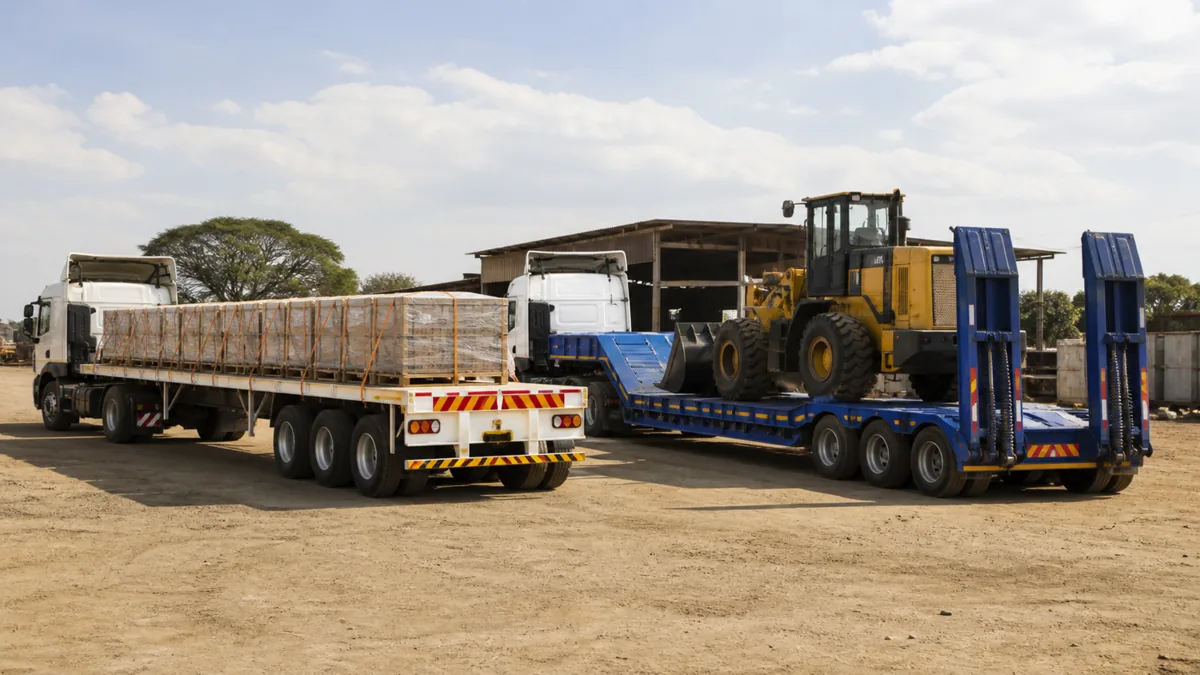
Direct answer: A flatbed trailer is usually better for normal-height cargo, containers, steel, bagged goods, timber, and general freight. A drop deck trailer is better when cargo is tall, heavy, or easier to load on a lower platform. For African routes, the decision should be based on cargo height, loading method, road clearance, axle load, permit risk, and workshop access.
The simple rule is this: use a flatbed when cargo is easy to load, easy to secure, and does not create height problems. Use a drop deck or low-bed type when deck height, machine height, loading angle, or center of gravity becomes a real risk.
Quick Buyer Decisions
- Choose flatbed for general cargo, pallets, steel, timber, bags, pipes, and some container work.
- Choose drop deck when cargo is too tall for a normal flatbed or needs a lower center of gravity.
- Measure total loaded height before asking for final trailer price.
- Check bridges, gates, ferries, weighbridges, ports, and customer yards on the route.
- Confirm loading method: forklift, crane, ramp, winch, or self-driving machine.
- Match axle group and suspension to route conditions and cargo weight.
- Do not buy a lower deck only because it looks stronger. Buy it because the route or cargo needs it.
What Is the Main Difference?
A flatbed trailer has one main deck level. It is simple, flexible, and easy to load from the side or top. This makes it useful for many African freight jobs: construction material, agricultural cargo, steel, timber, bags, equipment parts, and return loads.
A drop deck trailer has a lower main deck after the gooseneck or front section. The lower platform reduces loaded height and can improve stability for tall cargo. It can also make loading easier for some machinery, depending on ramp design. In many markets, buyers may also compare drop deck, step deck, and lowbed designs. The names vary by supplier, so always ask for drawings and deck-height data.
The IMO CTU Code page, accessed June 19, 2026 is a useful reminder that safe cargo transport depends on proper packing, securing, and handling of cargo transport units. A trailer buyer does not need to quote the code in every purchase order, but the core idea is important: cargo must fit the transport unit and must be secured for the route.
Decision Matrix
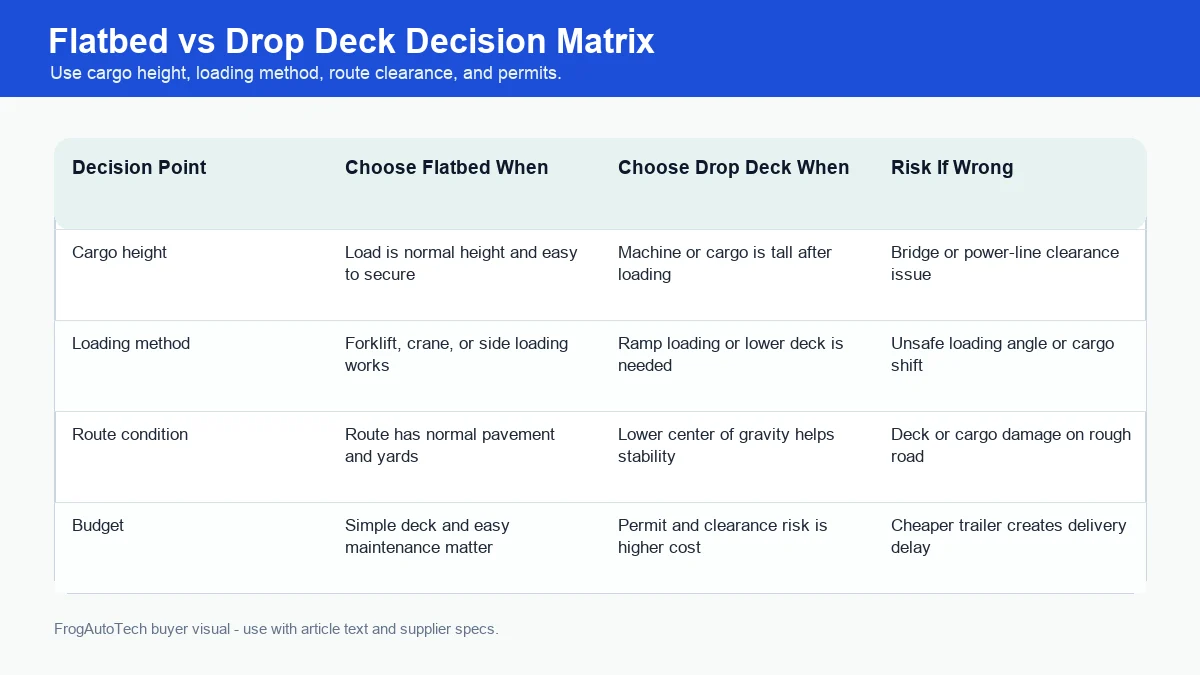
| Decision point | Flatbed is better when | Drop deck is better when |
|---|---|---|
| Cargo height | Cargo is normal height after loading | Cargo is tall and may hit route limits |
| Loading method | Forklift, crane, or side loading is available | Ramp loading or lower approach angle helps |
| Route clearance | Bridges, gates, and yards are not height-limited | Lower deck reduces clearance risk |
| Cargo type | General freight, steel, pallets, timber, bags | Construction machines, tall tanks, oversized equipment |
| Maintenance | Simple deck and easy repair matter most | More specialized frame can be maintained locally |
| Cost control | Budget and flexibility are key | Permit delay or cargo damage would cost more |
Cargo Height Comes First
Cargo height is often the first reason to choose a drop deck. Buyers sometimes compare only payload and axle count, but the loaded height can decide whether the cargo can pass under a bridge, port gate, warehouse entry, or power line.
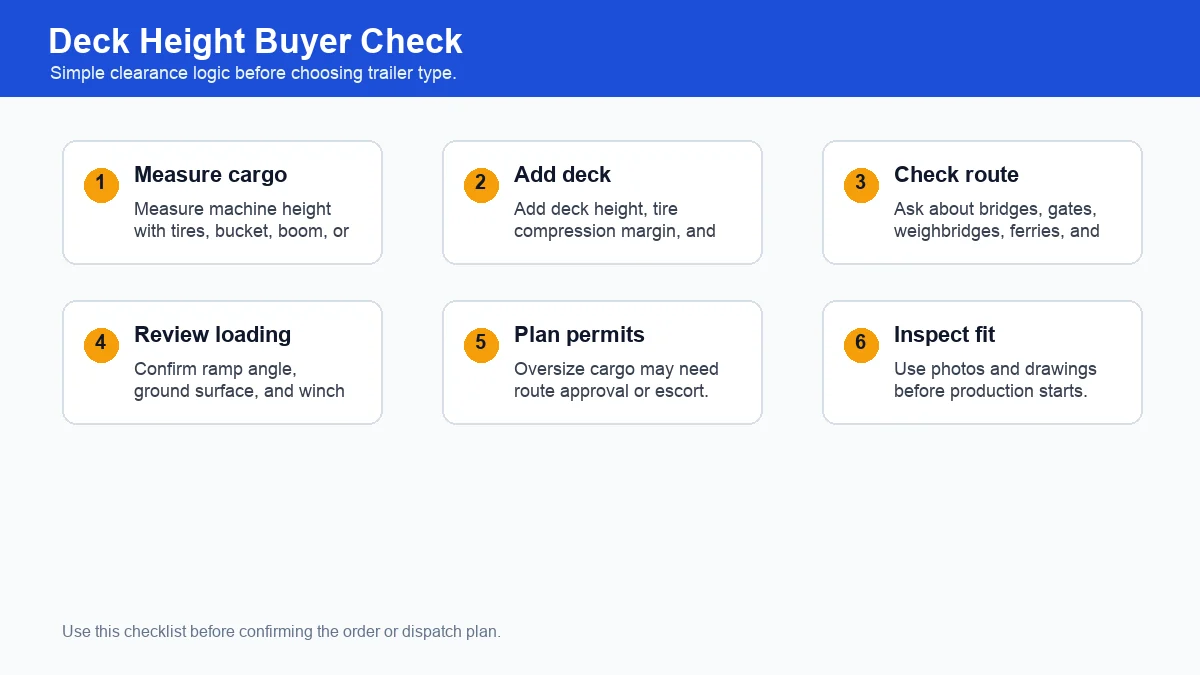
Use this simple calculation:
| Item | What to measure |
|---|---|
| Cargo height | Measure the machine or load in transport position |
| Deck height | Ask for empty and loaded deck height |
| Tire compression | Leave a small margin for loaded tire condition |
| Securement height | Add chains, blocks, supports, or protective frames if needed |
| Route clearance | Check low bridges, gates, ferries, and customer yards |
| Safety margin | Do not plan to pass with only a few centimeters of clearance |
For heavy machinery routes, a Lowbed Semi-Trailer can be more suitable than a normal flatbed because it lowers the machine position and can use ramps. If the cargo is a loader, excavator, drilling rig, or high industrial machine, compare lowbed drawings before finalizing the order.
Loading Method Changes the Trailer Choice
Flatbed trailers are easy to load when the buyer has forklifts, cranes, or side access. They are also practical when the cargo comes in pallets, bags, bundles, pipes, steel frames, or boxed equipment.
Drop deck trailers are useful when the cargo needs a lower loading angle. This matters for machines that drive onto the deck, tall equipment that cannot be lifted easily, or cargo that becomes unstable when loaded high. The ramp design, ground clearance, rear approach angle, and winch points should be part of the purchase discussion.
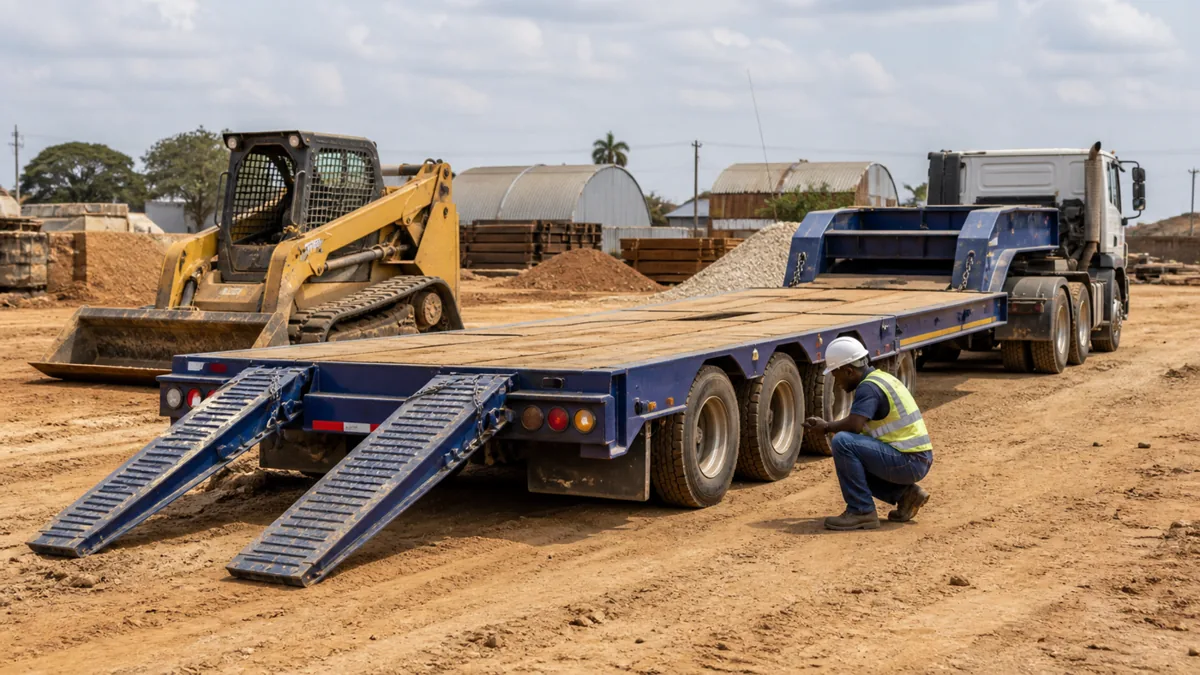
Use this loading check before ordering:
- Can the cargo be loaded by forklift from the side?
- Is a crane available at both loading and unloading points?
- Does the machine drive onto the trailer?
- Is the yard surface strong enough for ramp loading?
- Are the ramps wide and strong enough?
- Are there enough lashing points in the right positions?
- Can the driver inspect the load after the first 20 to 50 km?
Road Conditions and Axle Load Still Matter
A lower deck does not remove axle-load risk. The cargo weight still passes through the axle group, suspension, tires, kingpin, and frame. If the road is rough, wet, or damaged, the trailer needs enough strength and the right running gear.
The World Bank Transport overview, accessed June 19, 2026 discusses the need for resilient transport systems. For trailer buyers, resilience is practical. A route may include paved highways, rough yards, port waiting areas, rural sections, and mining or construction roads. The trailer should match the weakest part of the route, not only the best highway section.
Data point: The World Bank Transport overview, accessed June 19, 2026, says more than one billion people live more than 2 km from an all-weather road.
Before choosing a trailer, review the guide on trailer axle load capacity for African roads. It explains why axle group choice, tire load, and cargo position are central to safe operation.
Flatbed Use Cases
A flatbed trailer is often the best first trailer for a growing African fleet because it can serve many cargo types. It is simple, flexible, and easier to repair. It can carry return loads more often than a specialized trailer.
Good flatbed use cases include:
- Bagged grain, fertilizer, cement, and animal feed.
- Steel bars, pipes, profiles, and construction material.
- Timber with proper stakes and straps.
- Palletized imports from port to warehouse.
- Containers where the trailer is equipped and approved for the job.
- Farm machinery parts and smaller equipment.
- Project cargo that is not too tall.
For a closer look at flatbed cargo decisions, see Side Wall Trailer vs Flatbed for Cargo in Africa. Side protection, stake pockets, rope hooks, and deck surface can be more important than buyers expect.
Drop Deck Use Cases
A drop deck or low-bed design is better when the cargo is tall, heavy, or difficult to load. It can reduce total height and improve stability. It can also make machinery transport safer when the loading method is planned correctly.
Good drop deck use cases include:
- Excavators, loaders, graders, compactors, and road equipment.
- Tall industrial tanks or generators.
- Mining and construction machinery.
- Cargo with a high center of gravity.
- Oversized cargo that needs route checks.
- Machines that need ramp loading instead of crane lifting.
For more demanding mining or construction work, compare the 13 m Heavy-Duty Low Bed Semi Trailer with Hydraulic Ramps if the route requires ramps, stronger deck structure, and easier machinery loading.
Cost and Flexibility
Flatbed trailers usually give more daily flexibility. They are easier to load, easier to clean, and often easier to repair. A buyer who needs one trailer for many cargo types should start with a flatbed unless the route has clear height or loading problems.
Drop deck trailers can cost more and may be less flexible for normal freight. But they can save money when the alternative is cargo damage, failed route clearance, special lifting cost, or permit delay. In other words, a drop deck is not always cheaper to buy, but it can be cheaper for the job.
The World Bank Logistics Performance Index, accessed June 19, 2026 looks at supply-chain speed and reliability. For a trailer buyer, a wrong trailer choice can reduce reliability. A machine that cannot clear a gate or a load that needs a crane at the wrong site can delay the whole route.
Moving tall machines or mixed project cargo?
Compare loaded height, ramp angle, axle load, and route clearance before choosing flatbed or drop deck.
Buyer Checklist Before Order
Use this checklist before confirming the trailer:
| Check | Buyer action |
|---|---|
| Cargo drawing | Get length, width, height, weight, and center of gravity |
| Loaded height | Add deck height and cargo height |
| Route clearance | Check bridges, gates, ferries, weighbridges, and yards |
| Loading method | Confirm forklift, crane, ramp, winch, or self-loading machine |
| Axle and tires | Match axle load and tire rating to route and cargo |
| Suspension | Choose based on rough road, cargo protection, and service access |
| Lashing points | Confirm positions and rated strength |
| Spare parts | Confirm tire size, brake parts, suspension parts, and ramp parts |
| Photos and drawings | Approve supplier drawings before production |
If road vibration or cargo protection is a concern, also read How to Choose Trailer Suspension for the African Market. Suspension choice affects tire wear, cargo damage, and workshop maintenance.
FAQ
Is a drop deck trailer the same as a lowbed trailer?
Not always. Some suppliers use the terms loosely. A drop deck usually means a stepped deck with a lower main platform. A lowbed often means a lower and heavier design for machinery or oversized loads. Always compare drawings, deck height, ramp design, axle layout, and payload.
Which trailer is better for containers?
A standard flatbed or skeletal trailer is usually better for container work. A drop deck is not the first choice unless the cargo and route have special height or loading needs.
Which trailer is better for African rural roads?
The answer depends on cargo and route. A flatbed may be easier to repair and more flexible. A drop deck may be safer for tall or heavy machines. In both cases, tires, axle load, suspension, and frame strength matter.
Can a flatbed carry machinery?
Yes, if the machine height, weight, loading method, center of gravity, and route clearance are safe. For heavier or taller machines, a lowbed or drop deck may be safer.
Final Buyer Advice
Do not choose between flatbed and drop deck by price alone. Choose by job risk. If the cargo is normal height and easy to load, a flatbed may give the best value. If height, loading angle, or center of gravity creates risk, a drop deck or lowbed trailer may protect the cargo and the route schedule.
Measure first, then buy. A good trailer drawing can prevent a bad delivery day.