
Direct answer: Kenya trailer registration requirements usually start before the trailer arrives at Mombasa. The buyer should prepare the invoice, bill of lading, cancelled foreign logbook or export registration document when applicable, pre-shipment roadworthiness evidence, PIN or company documents, customs clearance file, chassis details, and inspection photos, then coordinate with the clearing agent and registration process before the trailer enters fleet work.
For a Kenyan buyer, registration is not a separate office task at the end. It depends on how the trailer is described in the commercial invoice, how the chassis number appears on the documents, whether import clearance is complete, and whether the trailer is ready for road checks. The registration file should be built while the trailer is still in production or at the loading port.
Quick Buyer Decisions
- Confirm whether the trailer is new, used, assembled, dismantled, or part of a tractor-trailer shipment.
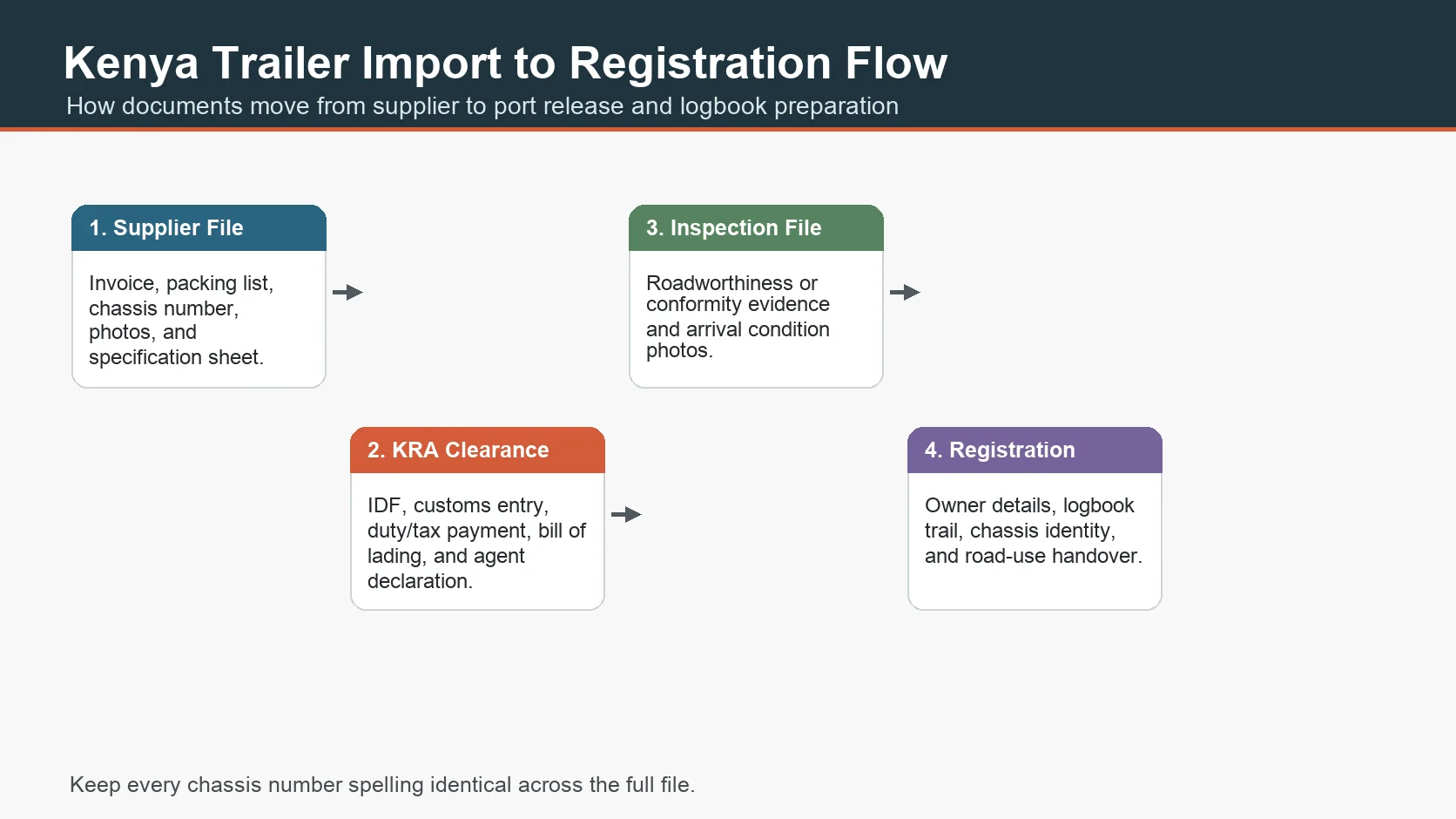
- Keep the chassis number identical across invoice, packing list, bill of lading, specification sheet, photos, and registration file.
- Use a Kenya-based clearing agent who understands vehicle and trailer imports, not only general container cargo.
- Confirm whether a pre-shipment inspection or roadworthiness certificate is needed for the shipment type.
- Prepare a logbook or export registration document trail before the trailer leaves the origin country.
- Do not send the trailer to work before tire, brake, lights, kingpin, reflector, and coupling checks are complete.
Start With Import Clearance, Not the Number Plate
Kenya trailer registration starts with import compliance. The Kenya Revenue Authority motor vehicle import page, accessed June 18, 2026, says imported vehicles must comply with Kenya Bureau of Standards requirements and notes roadworthiness inspection by a KEBS-appointed inspection agent in the country of export. KRA also lists import taxes and supporting documents such as original commercial invoice, original cancelled logbook from the country of importation, original bill of lading, pre-shipment inspection certificate, and PIN certificate or certificate of incorporation.
A trailer is not a passenger car, so the buyer should ask the clearing agent how the specific trailer is treated under the current tariff, inspection, and registration process. A skeletal trailer, lowbed, fuel tank semi-trailer, side wall trailer, and flatbed trailer may need different supporting details.
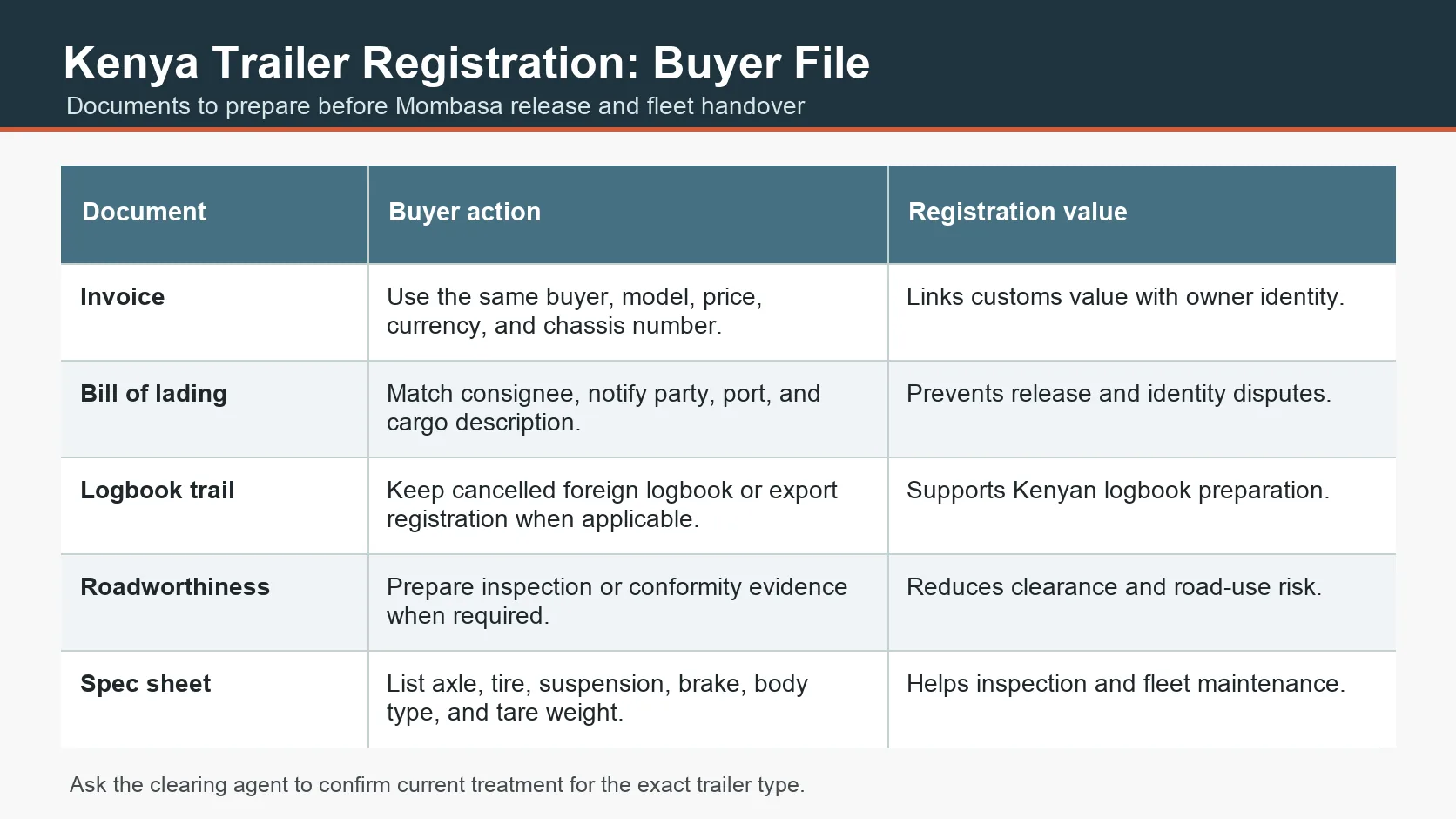
Core Documents to Prepare
Use one master document list for the supplier, forwarder, clearing agent, and buyer.
| Document | Why it matters for registration |
|---|---|
| Commercial invoice | Identifies buyer, seller, trailer model, price, currency, and chassis number |
| Packing list | Shows dimensions, weight, accessories, spare parts, and removable items |
| Bill of lading | Confirms shipment route, consignee, notify party, and cargo description |
| Cancelled foreign logbook or export document | Supports local logbook issuance where required |
| Pre-shipment inspection or roadworthiness certificate | Supports import compliance and condition proof |
| Buyer PIN or company certificate | Links the import to the registered owner |
| Trailer specification sheet | Confirms axle, tire, suspension, brake, kingpin, body type, and payload |
| Loading and arrival photos | Helps resolve condition, chassis identity, and missing-part disputes |
The KRA How to Import page, accessed June 18, 2026, says importing goods such as cars or machinery requires a customs clearing agent and lists items such as Import Declaration Forms, customs declaration, Certificate of Conformity for regulated products, import standards mark when applicable, and valid invoices. Even when a trailer shipment is not handled exactly like a passenger vehicle, the same discipline is useful: every document should describe the same cargo in the same way.
Mombasa Port and Clearing Agent Coordination
Many Kenya trailer imports enter through Mombasa. The Kenya Ports Authority homepage, accessed June 18, 2026, describes the Port of Mombasa as its flagship facility and says it connects Kenya and the East and Central Africa region to global markets. For trailer buyers, the practical point is simple: port clearance and registration preparation should be coordinated, because port storage can become expensive when documents are not ready.
Before the vessel arrives, confirm:
| Checkpoint | Buyer question |
|---|---|
| Cargo description | Is the trailer described consistently across all documents? |
| HS code and valuation | Has the agent checked current classification and duty treatment? |
| Roadworthiness | Is the required inspection evidence ready? |
| Release plan | Who receives the trailer after port release? |
| Tractor availability | Is the fifth wheel compatible with the kingpin? |
| Temporary movement | Can the trailer move legally from port to yard before final registration? |
| Storage risk | What is the free time and daily cost after expiry? |
For broader shipment cost planning, the article CIF vs FOB Trailer Shipping to Africa explains why the cheapest first freight quote can become more expensive after destination charges are added.
Trailer Specification Details That Affect Registration and Road Use
A registration file should not only show that a trailer exists. It should help the buyer prove that the trailer matches the declared model and can be used safely.
Ask the supplier to provide:
| Specification item | Why the buyer needs it |
|---|---|
| Chassis number | Main identity link across customs, registration, and inspection |
| Axle count and rating | Supports load planning and road checks |
| Tire size and load index | Helps replacement sourcing and safety inspection |
| Suspension type | Affects maintenance, ride, and road suitability |
| Brake system | Supports roadworthiness and fleet safety |
| Kingpin size | Prevents mismatch with tractor fifth wheel |
| Body type | Flatbed, side wall, skeletal, lowbed, fuel tank, or tipper use case |
| Gross and tare weight | Helps cost, permit, and payload planning |
If the buyer is still choosing trailer type, the Semi Trailer category is a useful starting point. For rough road or inland freight, also review how to choose trailer suspension for the African market and trailer axle load capacity for African roads.
Axle Load and Road Checks After Registration
Registration does not mean the trailer can carry any load. Kenya enforces axle-load controls on road corridors. The Kenya National Highways Authority axle load control page, accessed June 18, 2026, is the official entry point for axle-load control information. A buyer should confirm current legal limits, overload penalties, weighbridge process, and route rules with the clearing agent and transporter before the first trip.
For a flatbed, skeletal, lowbed, or fuel tank trailer, the load plan should show:
| Road-use item | Practical buyer check |
|---|---|
| Empty trailer weight | Confirm tare weight after import |
| Payload | Do not rely only on factory payload if local axle rules are lower |
| Axle distribution | Load heavy cargo over the right axle group |
| Tire pressure | Check before long highway movement |
| Brake test | Complete before leaving yard |
| Lighting and reflectors | Confirm before night movement |
| Coupling | Verify kingpin, fifth wheel, air line, and electrical plug match |
Kenya is also a regional route for Uganda and other inland buyers. If the trailer will later work beyond Kenya, the article Import Semi-Trailer to Uganda via Mombasa can support corridor planning.
Used Trailer vs New Trailer Registration Risk
Used trailers need extra care because documents and physical condition may not match cleanly. If the trailer has been repaired, repainted, or modified, the chassis number and specification photos become even more important.
For used trailers, check:
| Risk | How to reduce it |
|---|---|
| Old logbook mismatch | Compare chassis number and ownership documents before purchase |
| Hidden accident repair | Inspect frame, welding, deck, axle alignment, and suspension |
| Tire and brake wear | Budget for replacement before fleet use |
| Missing accessories | List landing gear handle, spare tire, toolbox, lights, and air lines |
| Age and inspection rule | Confirm current KEBS and KRA treatment before payment |
The existing guide on how to import a used trailer to Ghana is Ghana-specific, but its inspection logic is still useful: photograph the identity plate, chassis number, tires, brakes, lights, suspension, and underside before accepting a used unit.
Final Handover Checklist
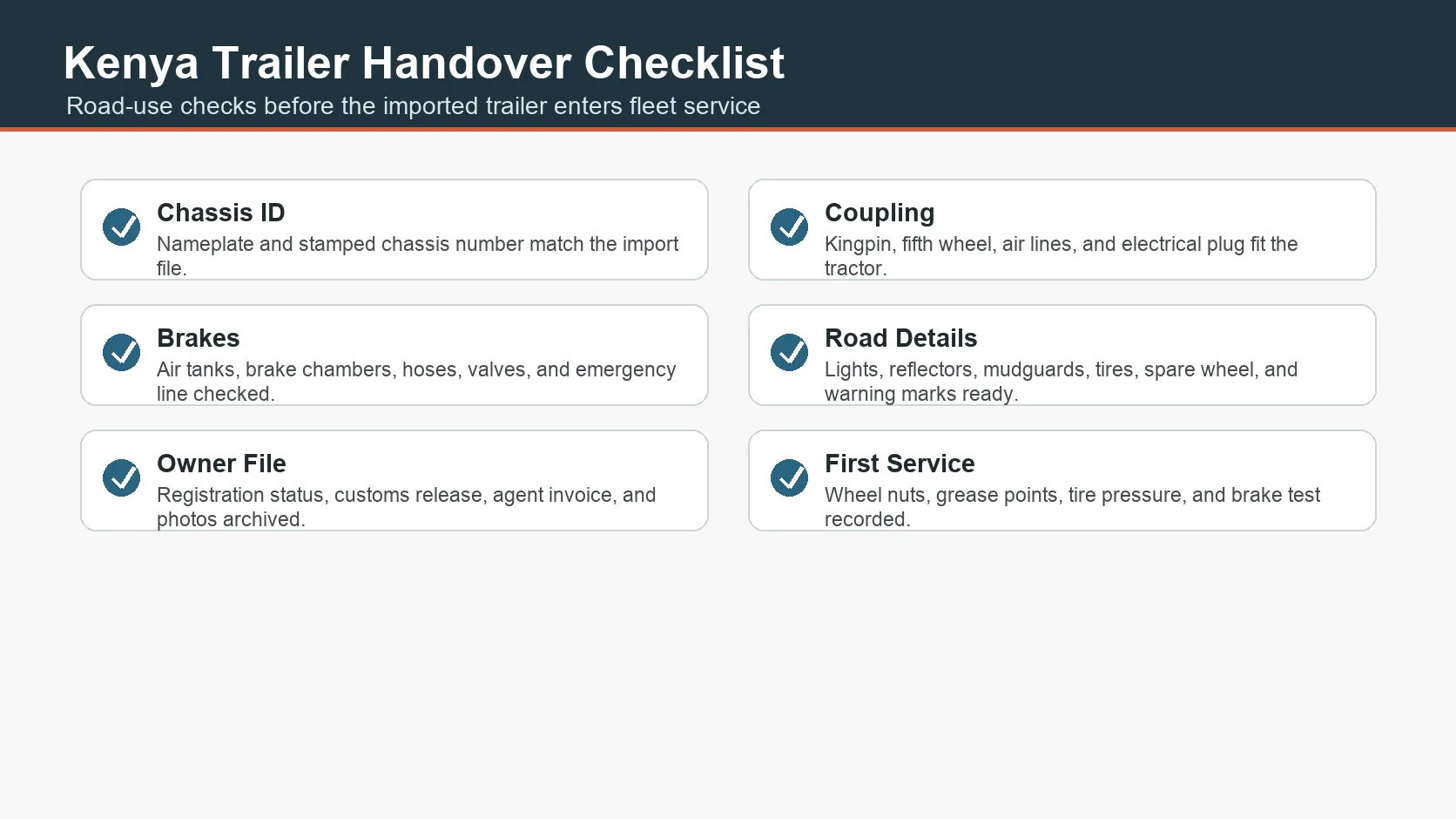
Before the trailer starts work, the buyer should complete a handover file:
| Handover item | Keep in file |
|---|---|
| Customs clearance | Entry, payment proof, release note, agent invoice |
| Registration file | Logbook or registration status, owner details, chassis number |
| Roadworthiness | Inspection evidence and repair notes |
| Photos | Factory, loading, arrival, inspection, and handover photos |
| Maintenance record | Grease points, tire pressure, brake test, torque check |
| Driver instruction | Coupling, air line, lights, load distribution, emergency contacts |
Conclusion
Kenya trailer registration requirements are easier to manage when the buyer starts early. Build the document file before shipment, use the same cargo description everywhere, keep chassis identity clean, coordinate with a qualified clearing agent, and inspect the trailer before road use. A well-prepared import file helps the buyer reduce port delay, registration confusion, and first-trip breakdown risk.