
Direct answer: Botswana trailer import for mining logistics should start with the mine cargo, not the trailer price. The buyer should confirm machine weight and dimensions, choose a lowbed or heavy-duty semi-trailer that fits the mine route, prepare customs and transit documents, check axle-load rules, plan abnormal-load permits when needed, and inspect the trailer before it moves from the border or yard to the mine site.
Botswana is landlocked, so many trailer imports move through a regional port and then travel inland by road. For mining fleets, this makes the trailer specification and route plan just as important as customs clearance. A lowbed that looks strong enough on paper can still create problems if the deck height, ramp angle, axle spacing, tire size, suspension, and turning radius do not match mine-road conditions.
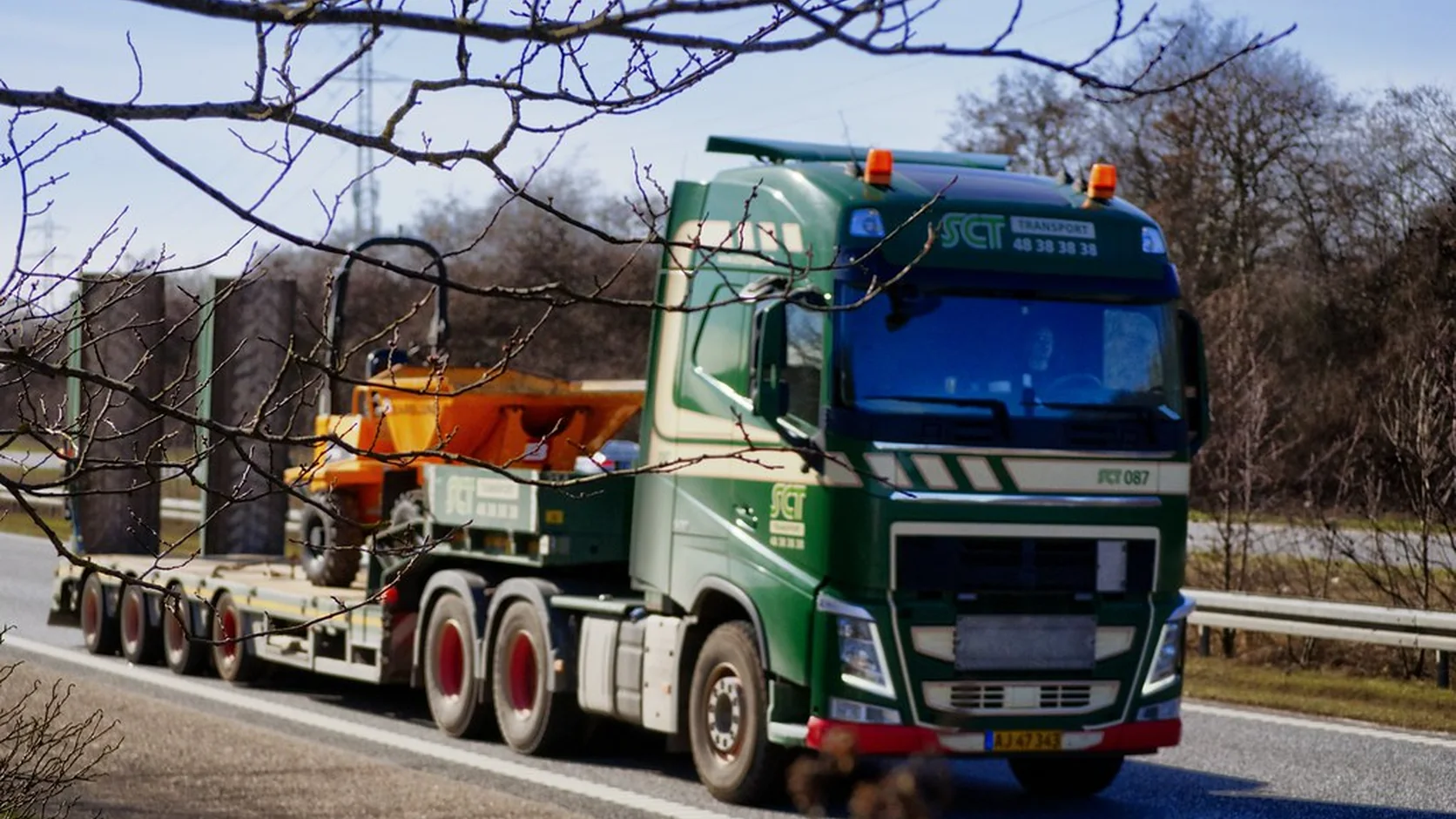
Quick Buyer Decisions
- Use the machine list first: excavator, loader, drilling rig, generator, compressor, dump-body parts, or camp equipment.
- Confirm route before production: port of entry, border post, Botswana transit route, weighbridge locations, and mine-access road.
- Choose axle layout by legal load distribution, not only by advertised payload.
- Ask whether the load is normal cargo or an abnormal load before booking the tractor.
- Keep customs clearance, police clearance, roadworthiness, and registration documents in one file.
- Inspect tires, brakes, ramps, landing gear, suspension, hydraulic lines, lights, and chassis number before the trailer leaves the arrival yard.
Why Mining Logistics Changes the Import Plan
Mining logistics in Botswana often involves long road movement, remote work sites, dust, heat, and heavy equipment. The imported trailer may first carry machinery to the mine, then keep working inside the mining supply chain. That means the buyer should not treat the first delivery as a one-time transport job.
The official Government of Botswana transport services page, accessed June 18, 2026, lists services for vehicle registration, axle-load monitoring, abnormal-load exemption certification, transit permits, and roadworthiness. For import buyers, that is a useful reminder: the trailer may need several checks after customs clearance before it can work safely and legally.
For heavy machinery, start with a load sheet:
| Cargo item | Buyer check | Trailer implication |
|---|---|---|
| Excavator | Operating weight, track width, center of gravity | Lowbed deck width, ramp strength, tie-down points |
| Wheel loader | Tire width, bucket position, loading angle | Deck height, gooseneck clearance, ramp angle |
| Drill rig | Overall height and mast condition | Route clearance and abnormal-load check |
| Generator or compressor | Skid base and lifting points | Flat deck support and lashing plan |
| Mine camp cargo | Mixed pallets and containers | Flatbed or side wall may be better than lowbed |
When the cargo is oversized or unusually heavy, compare the import plan with the Lowbed Semi-Trailer specification early. A lowbed is often the right choice for mining equipment, but the exact model should be built around the machine list and route.
Route and Permit Planning
A Botswana buyer may import through different regional routes depending on freight price, vessel schedule, customs agent capability, and final mine location. The best route is not always the route with the cheapest ocean freight. It is the route that gives the buyer predictable port handling, border handover, inland transport, and trailer inspection.
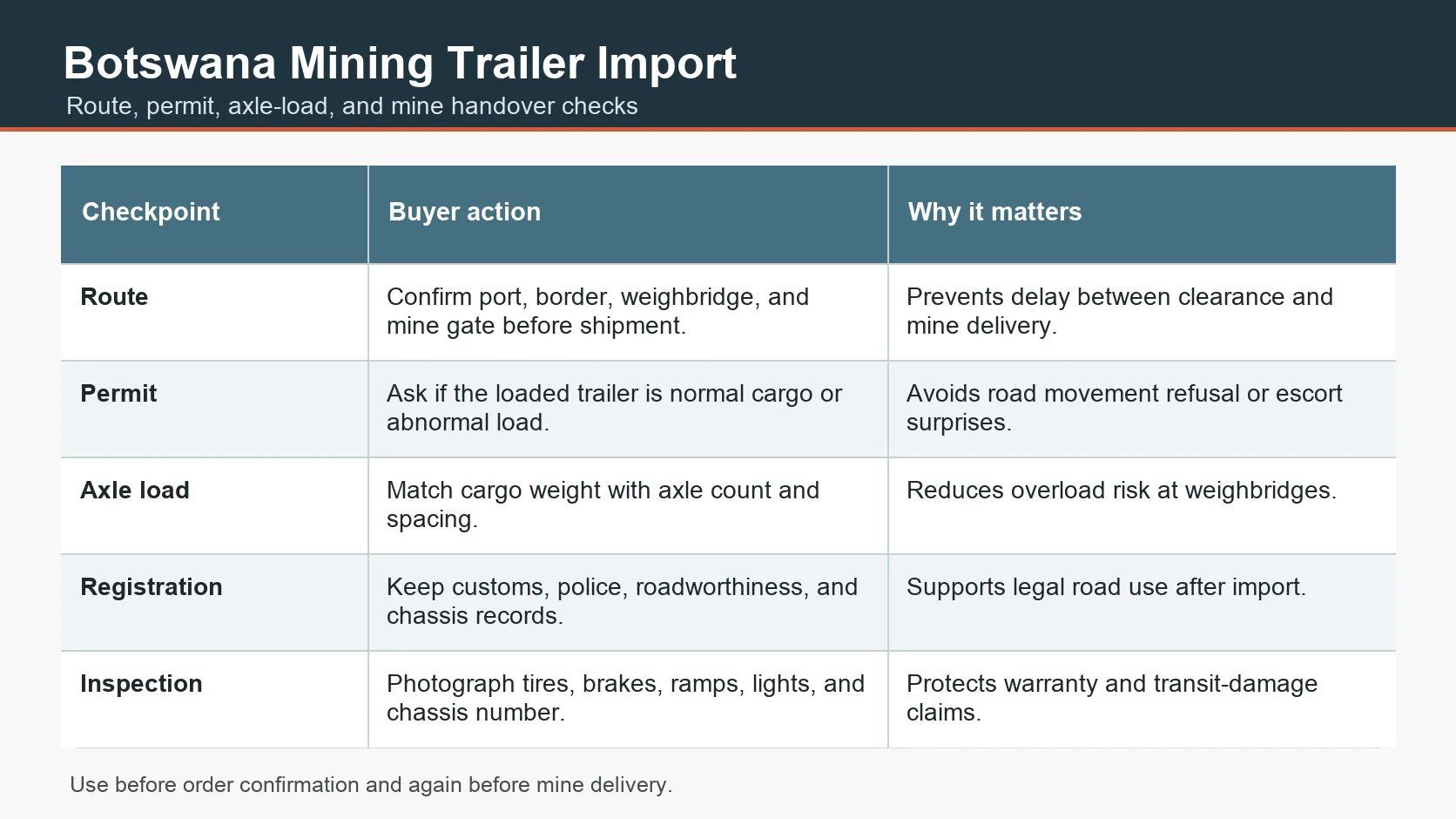
Before shipment, ask the forwarder and Botswana agent to confirm:
| Route item | What to confirm |
|---|---|
| Arrival port | Durban, Walvis Bay, Maputo, or another port option |
| Border point | Customs office, transit documents, and expected queue time |
| Tractor plan | Who supplies the tractor after arrival and who checks coupling |
| Route restriction | Height, width, bridge, roadworks, security, and night movement |
| Weighbridge | Whether the loaded combination must be weighed before mine delivery |
| Mine access | Gate time, road surface, turning space, unloading equipment |
The Government of Botswana Single Transit Permit page, accessed June 18, 2026, describes a transit single trip permit for foreign-registered vehicles moving goods through Botswana and lists supporting documents such as vehicle registration book, valid roadworthiness certificate, permit from country of origin, and consignment note. A mining buyer should treat these as planning signals even when the final case uses a local registered tractor or a different permit route.
Axle Load and Abnormal Load Control
Axle load can become the hidden cost in a mining trailer import. A stronger trailer does not solve the problem if the load sits on too few axles or if axle spacing creates a poor distribution. The Government of Botswana Axle Load Control monitoring page, accessed June 18, 2026, says vehicles above 3,500 kg are weighed at weighbridges and lists weighbridge locations with different operating hours.
For abnormal cargo, the Government of Botswana axle-load exemption certification page, accessed June 18, 2026, describes certificates for abnormal loads and says eligible applicants are transporters with loads that qualify as abnormal. That matters for lowbed imports because mining machines can exceed ordinary width, height, mass, or axle distribution limits.
Use this pre-order check before confirming the lowbed:
| Specification area | Mining logistics check |
|---|---|
| Axles | 3-axle, 4-axle, or modular option based on loaded axle group |
| Suspension | Mechanical suspension for rugged service or air suspension where route and service support justify it |
| Tires | Common tire size available locally, with load rating and spare plan |
| Ramps | Mechanical or hydraulic ramp based on machine weight and site service ability |
| Deck height | Low enough for route clearance but high enough for road condition |
| Kingpin and fifth wheel | Match tractor coupling and turning clearance |
| Brake system | Air tank, brake chambers, ABS/EBS expectation, hose protection |
The related guide on trailer axle load capacity for African roads gives more background on why payload, axle layout, and road limits must be checked together.
Documents for Import and Registration
The import file should be complete before the trailer leaves the factory. Missing chassis details, vague cargo descriptions, or mismatched company names can slow down clearance and registration.
Prepare these documents:
| Document | Buyer action |
|---|---|
| Sales contract | Match buyer name, trailer model, Incoterm, and payment terms |
| Commercial invoice | Use a clear description such as lowbed semi-trailer or flatbed semi-trailer |
| Packing list | Include dimensions, gross weight, accessories, spare tire, and removable parts |
| Bill of lading | Match consignee, notify party, port, and freight term |
| Chassis number list | Match nameplate, invoice, and photos |
| Specification sheet | Show axle, suspension, tire, brake, kingpin, deck, ramp, and payload |
| Loading photos | Record condition before shipment and lashing before vessel departure |
| Agent instructions | Confirm customs, border, registration, and mine-delivery responsibility |
The Government of Botswana Vehicle Registration and Licensing page, accessed June 18, 2026, says all vehicles on Botswana roads should be registered in the government vehicle registration system and notes customs clearance, police clearance, fees by vehicle weight, and roadworthiness testing for vehicles three years and above. Mining buyers should verify the current local treatment of a new imported trailer, a used trailer, and any imported tractor-trailer combination with the registration office or agent.
Trailer Type Choices for Botswana Mines
Not every mining logistics job needs a lowbed. A mine fleet may need several trailer types if it carries different cargo categories.
| Mining work | Trailer type to evaluate | Main specification focus |
|---|---|---|
| Excavators and loaders | Lowbed trailer | Payload, ramp, deck height, axle layout |
| Steel structures and pipes | Flatbed trailer | Deck length, twist locks, lashing points |
| Fuel supply | Fuel Tank Semi Trailer | Compartment, valve, safety fittings |
| Construction material | Tipper, side wall, or flatbed | Body strength, suspension, tires |
| Mixed camp supply | Flatbed or side wall | Return-load flexibility and tarpaulin plan |
For mine sites with rough approach roads, compare suspension choices with the guide on how to choose trailer suspension for the African market. If the same fleet also crosses Zambia or Zimbabwe, the existing articles on Zambia trailer import regulations and Zimbabwe trailer import for mining transport can support route planning.
Arrival Inspection Before Mine Delivery
The arrival inspection should happen before the trailer enters mine service. Mining sites are hard on equipment, so the buyer needs a clean baseline record.
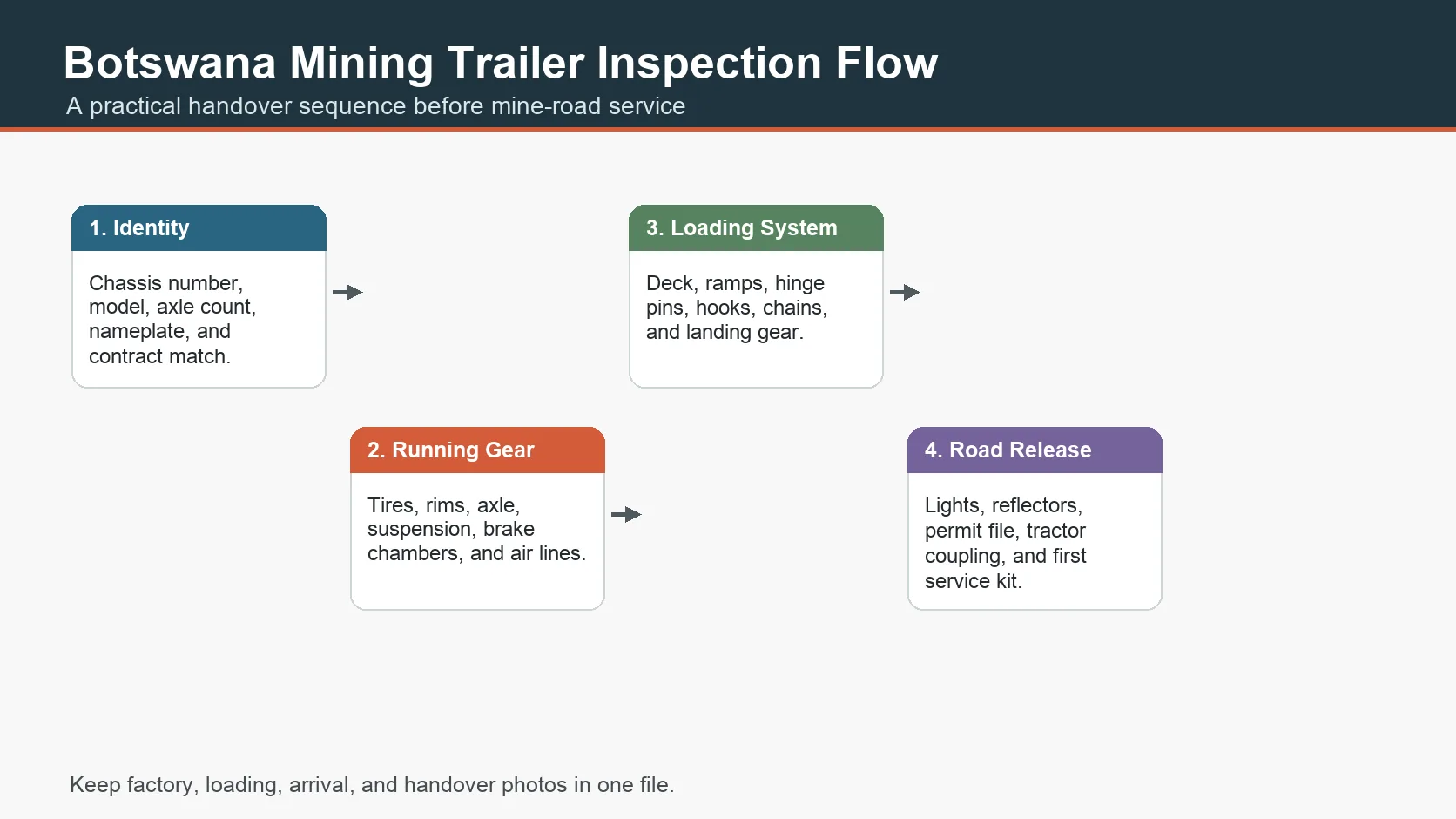
Inspect these areas:
| Area | What to photograph |
|---|---|
| Identity | Chassis number, nameplate, model, axle count |
| Tires | Size, tread, sidewall, pressure, rim condition |
| Brakes | Air lines, chambers, tanks, valves, connectors |
| Suspension | Leaf springs, equalizer, air bags, mounting bolts |
| Deck and ramp | Welding, paint damage, ramp hinge, ramp cylinder |
| Electrical | Lights, plug, wiring protection, reflectors |
| Accessories | Tool box, spare tire, hooks, chains, manuals |
If damage is found, document it before the trailer leaves the yard. A claim is much stronger when factory photos, loading photos, shipping documents, arrival photos, and inspection notes all match.
Conclusion
Botswana trailer import for mining logistics is a route, permit, axle-load, and specification project. The safest buyer workflow is to confirm the cargo list, route, axle distribution, abnormal-load status, customs file, registration path, and arrival inspection before the trailer is built. A trailer that is correctly matched to mining equipment and local road conditions will cost less to operate than a cheaper unit that loses time at the border, weighbridge, or mine gate.