
Direct answer: To import trailer to Sudan Port Sudan, the buyer should confirm the trailer specification, screen every party in the transaction, prepare matching shipping documents, choose a clear freight term, appoint a Sudan-based clearance agent, and plan inland movement before the vessel arrives. Port Sudan can handle commercial cargo flows, but Sudan imports need tighter document control and compliance checks than many routine African trailer shipments.
For a trailer buyer, the goal is not only to get the trailer onto a ship. The goal is to make sure the semi-trailer can be accepted by the carrier, cleared by the local agent, released from the port, inspected on arrival, and put into work without avoidable delay. That means the import plan should connect factory production, shipment term, Sudan documentation, local agent instructions, inland route, spare parts, and after-arrival inspection.
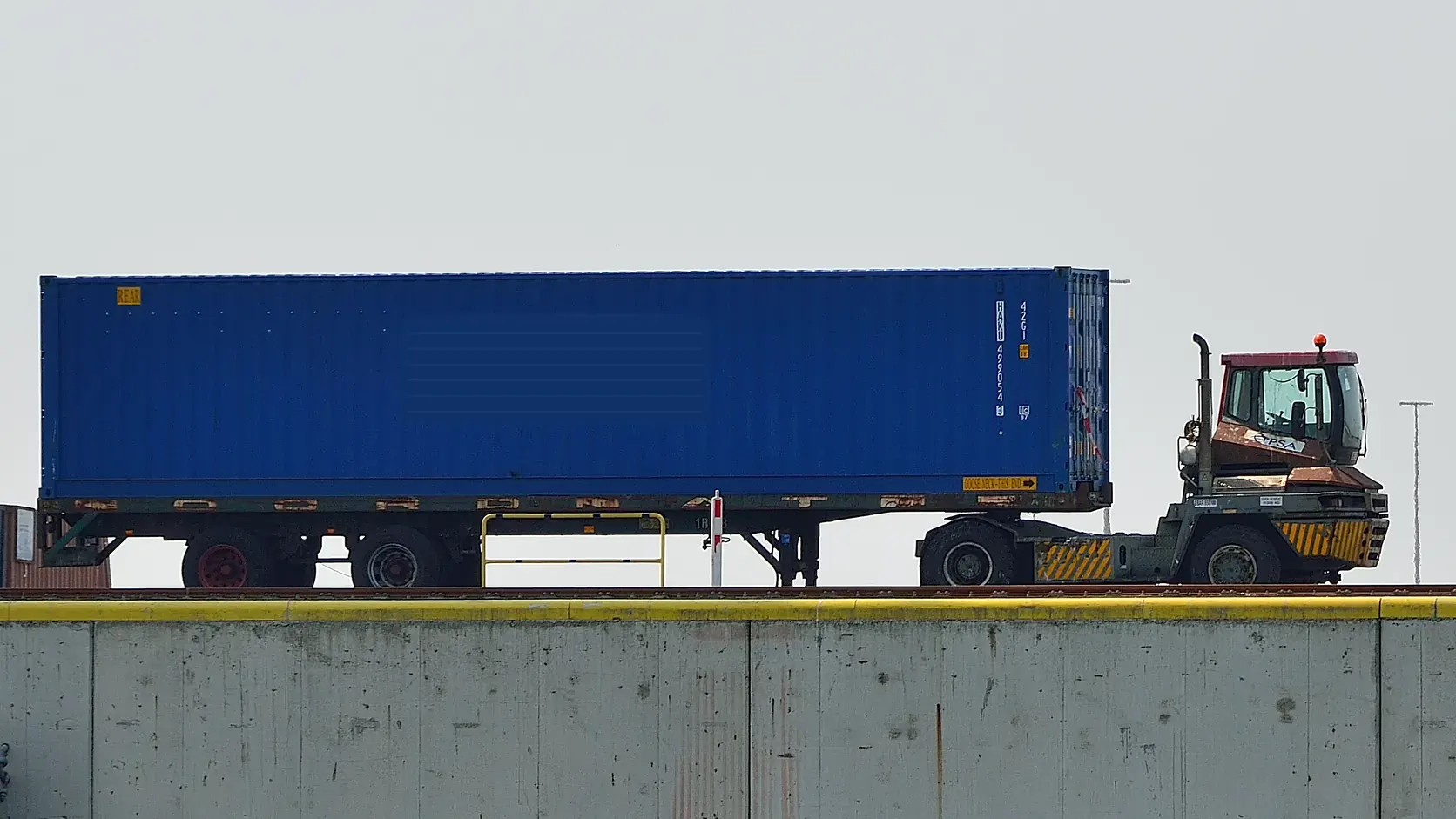
Quick Buyer Decisions
- Treat Sudan as a compliance-first shipment: screen the buyer, consignee, end user, bank, carrier, vessel, forwarder, and payment route before confirming the order.
- Ask the Port Sudan agent to confirm the likely port service route, terminal handling, local charges, document language, and release process before shipment.
- Use one consistent cargo description across the invoice, packing list, bill of lading draft, contract, chassis number list, and specification sheet.
- Choose the trailer by Sudan work route: port delivery, construction, mining support, fuel distribution, agricultural freight, or inland general cargo.
- Compare CIF and FOB by landed cost, not by the first quotation line.
- Inspect the trailer before China loading and again after Port Sudan release, with photos of the chassis number, tires, brakes, lights, landing gear, and accessories.
Port Sudan Planning Starts Before the Trailer Leaves China
Port Sudan planning should start before shipment because port release depends on documents, local handling, and agent coordination. The official Sudan Sea Ports Corporation official site, accessed June 18, 2026 lists service areas connected to North Port, South Port, container location, tariff, statistics, and vessel movement. That is useful for orientation, but the buyer still needs a live local agent to confirm the current path for a semi-trailer.
A semi-trailer is not always handled like a normal box of cargo. Depending on the booking, it may move by RoRo, breakbulk, flat rack, or another arrangement. Each choice changes cost, risk, lashing, insurance, and arrival inspection.
Ask these questions before the bill of lading draft is approved:
| Buyer question | Why it matters |
|---|---|
| Which port service or terminal will receive the trailer? | Prevents confusion after arrival |
| Will the trailer ship assembled or partly dismantled? | Affects handling and inspection |
| Which freight term is written in the contract? | Controls cost and risk split |
| Who is the consignee and notify party? | Affects document release |
| Which local agent handles clearance? | Prevents last-minute agent search |
| Who provides the tractor after release? | Avoids port storage delay |
| Where will the arrival inspection happen? | Protects claims for damage or missing parts |
If the cargo will be general freight after import, the comparison in Side Wall Trailer vs Flatbed for Cargo in Africa can help the buyer choose a flexible body type. If the trailer will work in mining, equipment movement, or heavy construction, compare the Lowbed Semi-Trailer before locking the order.
Compliance Screening Comes Before Price Negotiation
Compliance screening comes before price negotiation because Sudan-related restrictions can affect banks, insurers, carriers, forwarders, and suppliers even when the cargo is ordinary commercial equipment. The U.S. Treasury OFAC Sudan and Darfur Sanctions page, accessed June 18, 2026 says Sudan-related sanctions authorities remain in effect under E.O. 14098 and E.O. 13400, and the page lists Sudan-related actions in 2026. OFAC's recent Sudan actions on that page were dated April 17, 2026, March 9, 2026, and February 19, 2026. The United Nations 1591 sanctions materials, accessed June 18, 2026 also maintain Sudan sanctions list materials, including measures such as asset freeze and travel ban.
For a trailer buyer, this does not mean every Sudan shipment is automatically blocked. It means the buyer should not treat the shipment as a simple price-and-freight transaction. The safest commercial workflow is to check the parties and route before any deposit, letter of credit, or carrier booking.
Screen at least these items:
| Screening item | Practical check |
|---|---|
| Buyer and end user | Confirm legal name, address, business activity, and ownership |
| Consignee and notify party | Match names with shipping documents and agent instructions |
| Bank and payment path | Confirm the bank can process the transaction |
| Carrier, vessel, and forwarder | Check whether the logistics chain accepts the cargo and route |
| Cargo description | Avoid vague names such as "vehicle parts" if the cargo is a semi-trailer |
| Final use | Confirm the trailer is for lawful commercial transport, construction, mining, fuel, agriculture, or logistics work |
This step is especially important when a shipment uses USD settlement, international insurance, global carriers, or finance documents. A buyer should keep written evidence of the checks performed and should use a qualified trade compliance adviser when the transaction has any uncertainty.
Document Checklist for Sudan Trailer Imports
The document checklist should be completed before the trailer leaves the factory. Correcting the invoice, packing list, bill of lading, or chassis number list after arrival can delay clearance and create storage cost.
The ITA Sudan Import Requirements and Documentation page, last published July 30, 2022 advises companies to consult Sudanese authorities such as the Ministry of Industry and Trade and the Central Bank of Sudan on requirements. For a trailer shipment, that means the buyer should not rely only on a previous import memory. Ask the Sudan-based agent to confirm current document and banking expectations before the shipment is booked.
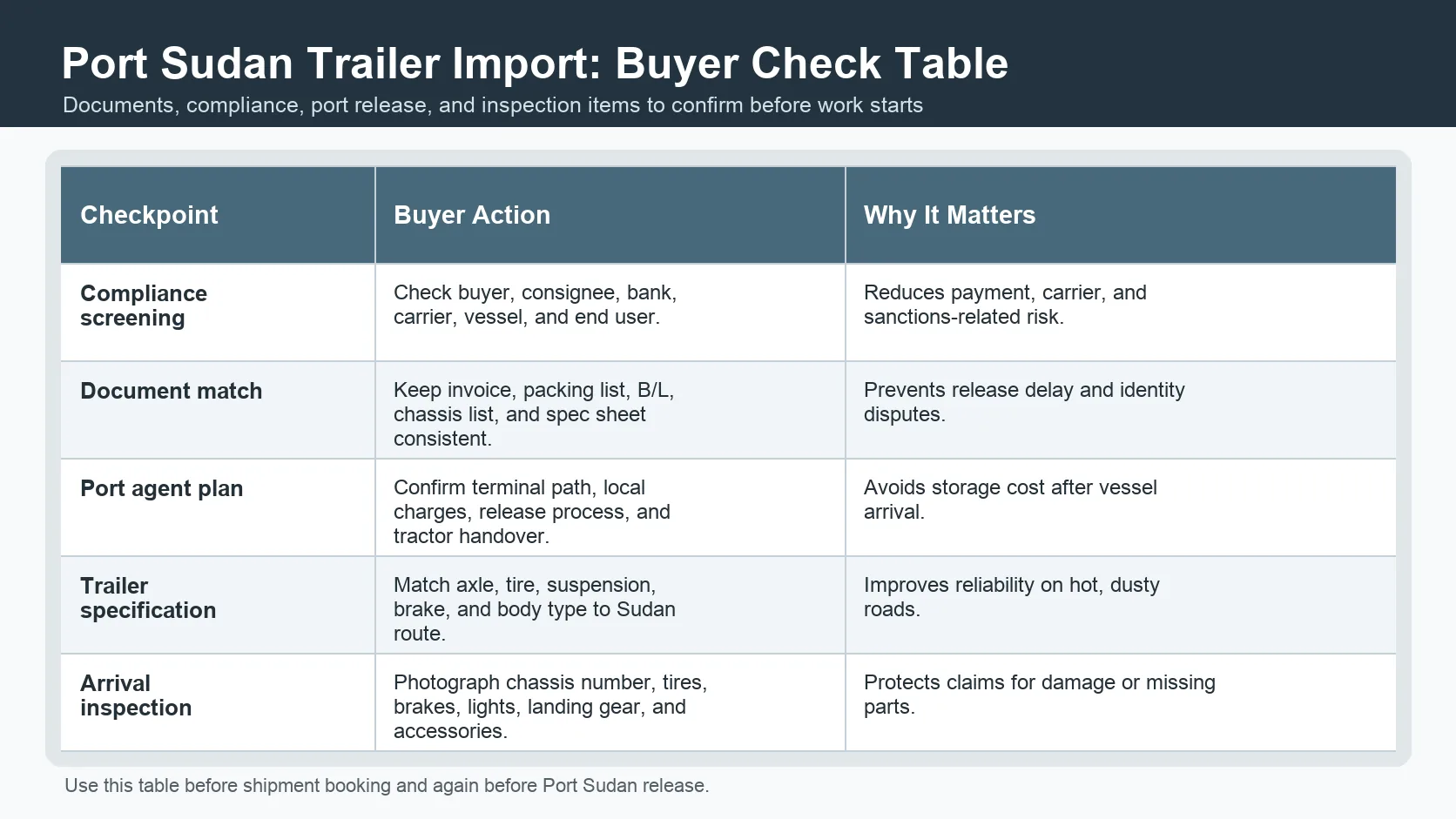
| Document | Buyer check | Common mistake to avoid |
|---|---|---|
| Sales contract | Seller, buyer, trailer model, price, Incoterm | Contract term differs from invoice |
| Commercial invoice | Same buyer name, model, quantity, price, currency | Vague product name |
| Packing list | Dimensions, gross weight, chassis details, accessories | Missing removable parts |
| Bill of lading draft | Consignee, notify party, port, freight term | Wrong spelling or old company name |
| Trailer specification sheet | Axle, tire, suspension, brake, body, payload | Spec sheet not matching final build |
| Chassis number list | Same numbers as nameplate and photos | One digit mismatch |
| Loading photos | Factory, port, lashing, spare parts | Photos taken too late |
| Insurance certificate | Coverage, insured value, claim process | Cargo risk not clearly covered |
| Compliance file | Screening records and party details | No written screening record |
The buyer should also ask the agent whether an Arabic product description, HS code confirmation, certificate, inspection record, or bank document format is needed for the current shipment.
Trailer Type Selection for Sudan Work Routes
Trailer type selection for Sudan should follow the actual cargo and route, not only the lowest factory price. Heat, dust, long road distance, service access, and tire condition matter. A trailer that works well on short port delivery may not be the best option for inland mining, construction, or fuel distribution.
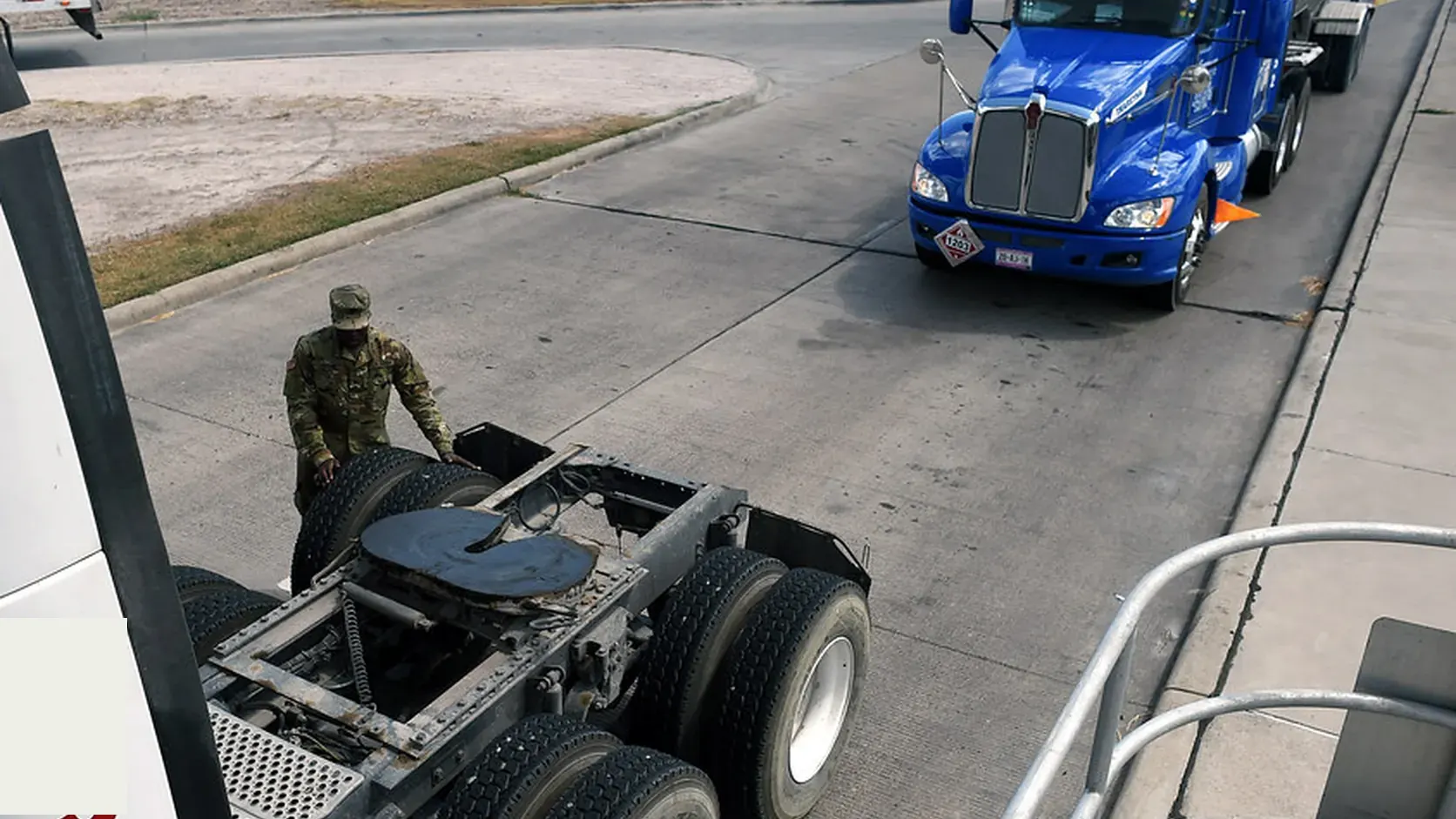
| Work plan after import | Trailer type to evaluate | Specification focus |
|---|---|---|
| Container or port cargo | Skeletal trailer or flatbed | Twist locks, frame strength, deck layout |
| Construction materials | Tipper, side wall, or flatbed | Body strength, suspension, tire load |
| Mining support | Lowbed trailer | Payload, axle layout, ramp, ground clearance |
| Fuel distribution | Fuel Tank Semi Trailer | Tank compartments, valves, safety fittings |
| Agricultural cargo | Flatbed or side wall | Tarpaulin, tie-downs, side protection |
| Mixed inland freight | Flatbed or side wall | Return-load flexibility and easy maintenance |
| Vehicle transport | Lightweight 6-8 Vehicle Carrier Semi Trailer | Deck angle, loading ramps, tire clearance |
For rougher routes, prioritize the running gear. The guides on trailer axle load capacity for African roads and how to choose trailer suspension for the African market are useful before confirming axle brand, leaf spring pack, tire rating, and brake system.
CIF vs FOB for Port Sudan Shipments
CIF and FOB should be compared by total landed cost. The International Chamber of Commerce explains that ICC Incoterms rules, accessed June 18, 2026 clarify the tasks, costs, and risks involved in delivery between seller and buyer. ICC also states that Incoterms 2020 entered into force on January 1, 2020. For a Sudan trailer import, the Incoterm should be written in the contract and repeated consistently in the invoice and logistics file.
CIF Port Sudan can be easier for a first-time buyer because the supplier arranges main freight and insurance to the named port. FOB China port can be better when the buyer has a trusted forwarder and wants direct control over carrier selection, freight cost, and sailing schedule. Neither term automatically includes Sudan customs cost, port release, local storage, inland delivery, or after-arrival repair.
Use this cost stack before choosing:
| Cost block | What to confirm |
|---|---|
| Factory price | Final specification, spare parts, accessories |
| China inland cost | Pickup point, port delivery, export handling |
| Ocean freight | Shipment method, carrier, route, booking validity |
| Insurance | Insured value, coverage, claim contact |
| Port Sudan local cost | Terminal, agent, port charges, release timing |
| Customs and taxes | Current estimate from local agent |
| Inland movement | Tractor, driver, permit, route, parking |
| First service kit | Tires, lights, air lines, brake fittings, tools |
The related article CIF vs FOB Trailer Shipping to Africa explains why the cheapest first quotation can become more expensive after destination charges are added.
Port Sudan Arrival Inspection
Arrival inspection should happen before the trailer starts work. The buyer should check whether the trailer that arrived is the same trailer that was ordered and photographed in China. This inspection also protects the buyer if there is transit damage, missing accessories, tire damage, paint damage, or brake-line issues.
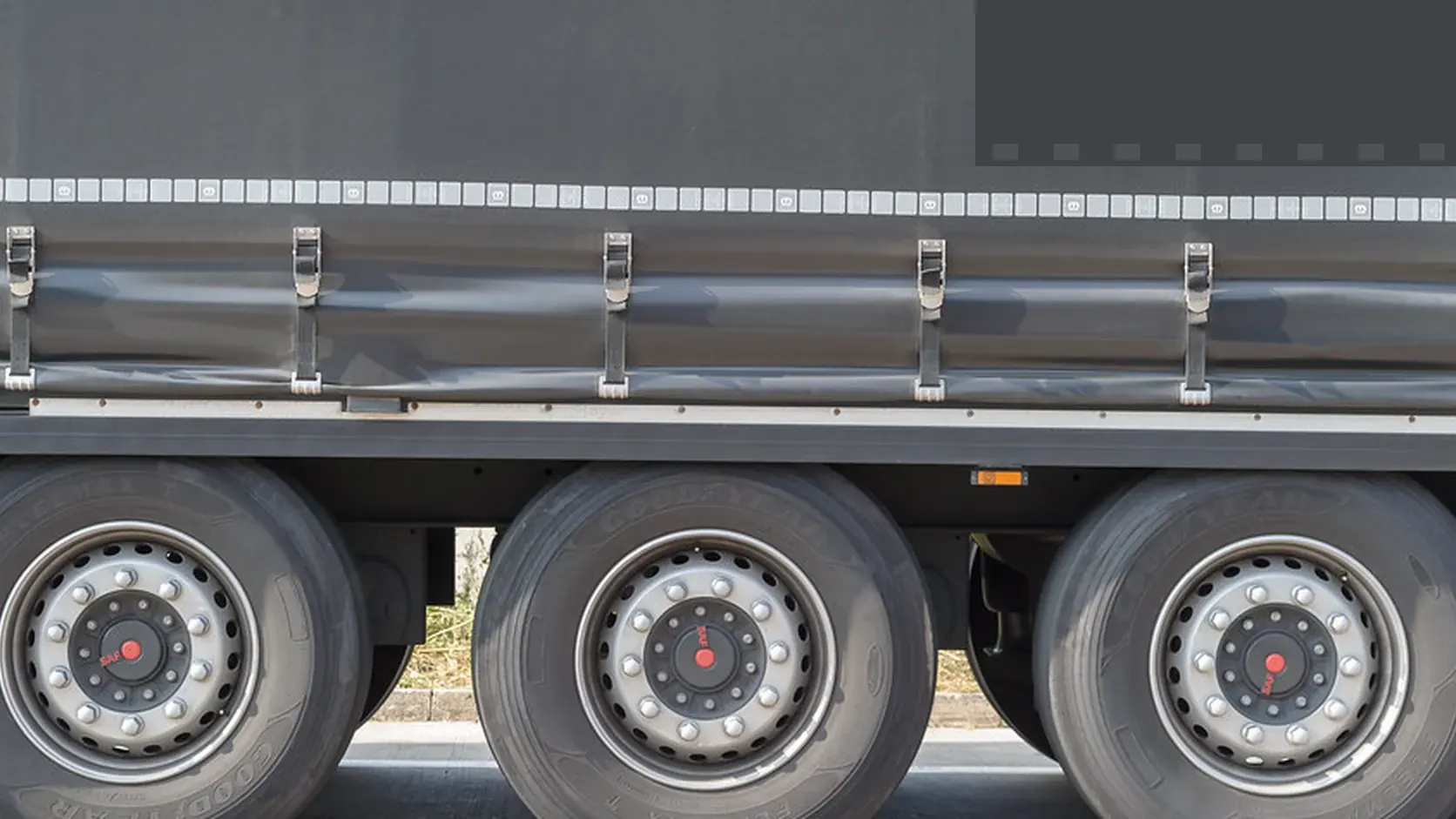
| Inspection area | What to check |
|---|---|
| Identity | Chassis number, model, nameplate, contract match |
| Tires and rims | Tire size, cracks, pressure, rim damage |
| Axles and suspension | Leaf springs, air suspension parts, axle alignment |
| Brake system | Air tank, chambers, valves, hoses, connectors |
| Electrical system | Lights, cable, plug, reflectors |
| Landing gear | Handle, lifting movement, mounting bolts |
| Body and deck | Welding, paint, corrosion, floor, side wall, ramp |
| Accessories | Spare tire, toolbox, hooks, straps, manuals |
| Documents | Invoice, packing list, bill of lading, photos |
If damage is found, take dated photos before the trailer leaves the inspection point. Notify the supplier, forwarder, insurer, and agent quickly. A claim is much easier to support when the buyer has factory photos, loading photos, arrival photos, and a written inspection note.
Inland Route Planning After Port Release
Inland route planning after Port Sudan release should include road condition, security updates, fuel availability, driver plan, parking, and maintenance access. The World Bank Logistics Performance Indicators 2025 describes its latest 2023-2024 dataset as shipment-level operational data and highlights unpredictability around ports, transshipment hubs, and inland checkpoints. For Sudan trailer buyers, that is a practical reminder to build schedule buffer into the first delivery plan.
The buyer should decide whether the trailer will leave port immediately with a tractor or wait in a yard for inspection. If it waits, confirm who is responsible for security, tire protection, and storage cost. If it moves inland immediately, confirm the tractor kingpin and fifth-wheel match, air connection, light plug, and brake test before departure.
Before inland movement, confirm:
- Tractor compatibility with the semi-trailer kingpin and air lines.
- Driver experience with imported semi-trailer handling.
- Route and parking plan from Port Sudan to the buyer yard.
- Fuel and tire support along the route.
- First workshop capable of brake, tire, lighting, and suspension checks.
- Spare tire, jack, warning triangle, air hose, and basic tools.
Spare Parts for the First 90 Days
The first 90 days of work are where small missing parts can become expensive downtime. A Sudan trailer import should include a basic service kit matched to the trailer type. For flatbed, skeletal, and side wall trailers, prioritize lights, wiring plugs, air hoses, brake fittings, wheel nuts, grease points, and tire plan. For lowbed trailers, add ramp-related service parts and hydraulic checks where applicable. For fuel tank trailers, ask the supplier for valve, gasket, and safety fitting recommendations.
Keep these parts listed on the packing list or accessory list. If accessories are placed inside a toolbox or tied to the trailer, photograph them before loading.
Frequently Asked Questions
Can buyers import a trailer to Sudan through Port Sudan?
Yes. Port Sudan is the main practical route for many Sudan sea imports, but the buyer should confirm the current port handling path, customs process, payment route, and compliance requirements with a Sudan-based agent before shipment.
What documents are needed to import trailer to Sudan Port Sudan?
A typical file includes the sales contract, commercial invoice, packing list, bill of lading draft, trailer specification sheet, chassis number list, loading photos, insurance document, and any agent-requested certificate or bank document.
Is CIF Port Sudan better than FOB China?
CIF Port Sudan is simpler when the buyer wants the supplier to arrange main freight and insurance. FOB China port gives experienced buyers more freight control. The better choice depends on landed cost, carrier acceptance, insurance, destination charges, and the buyer's forwarder strength.
Which trailer type is best for Sudan?
The best trailer depends on the job. Container and port cargo may need skeletal or flatbed trailers, mining may need lowbed trailers, fuel distribution needs tank trailers, construction may need tippers or side wall trailers, and general freight often needs flatbed or side wall trailers.
Why is compliance screening important for Sudan trailer imports?
Compliance screening is important because Sudan-related sanctions and party restrictions can affect banks, insurers, carriers, forwarders, and payment routes. Screen the buyer, end user, consignee, bank, vessel, carrier, and forwarder before payment or shipment booking.
Conclusion
To import trailer to Sudan Port Sudan, treat the project as a controlled logistics and compliance workflow. Confirm the trailer specification, screen all parties, align documents, choose the freight term, appoint a capable Port Sudan agent, plan inland movement, and inspect the trailer before it enters service. A careful import file helps the buyer reduce delays and gives the trailer a better first month of work.